Contact Us
If you have a commercial, industrial, infrastructure or heritage structural repair enquiry, contact us now. We will respond within one working day. Please note we do not provide services for domestic properties.

If you have a commercial, industrial, infrastructure or heritage structural repair enquiry, contact us now. We will respond within one working day. Please note we do not provide services for domestic properties.
Business enquiries:
When water breaches a concrete structure – whether it is a commercial basement, a subterranean car park, or a civil tunnel – it is rarely a passive drip. It is usually driven by immense hydrostatic pressure from the surrounding ground. This water ingress not only damages internal assets and disrupts operations, but it also carries corrosive elements that actively attack the embedded steel reinforcement. A leaking crack is a structural failure in progress.
The industry is full of reactive, low-level waterproofing attempts. When a facility manager or standard contractor tries to stop a high-pressure leak by painting a waterproof slurry over the surface or packing the crack with hydraulic cement, they are fighting a losing battle.
Surface patches do not penetrate the concrete matrix. The hydrostatic pressure behind the wall remains completely unrelieved. Within months—or sometimes days—the water will either physically blow the rigid patch off the wall or simply travel along the path of least resistance to open a new crack further down the slab. To permanently stop water ingress, you must attack the problem from within the core of the concrete itself.
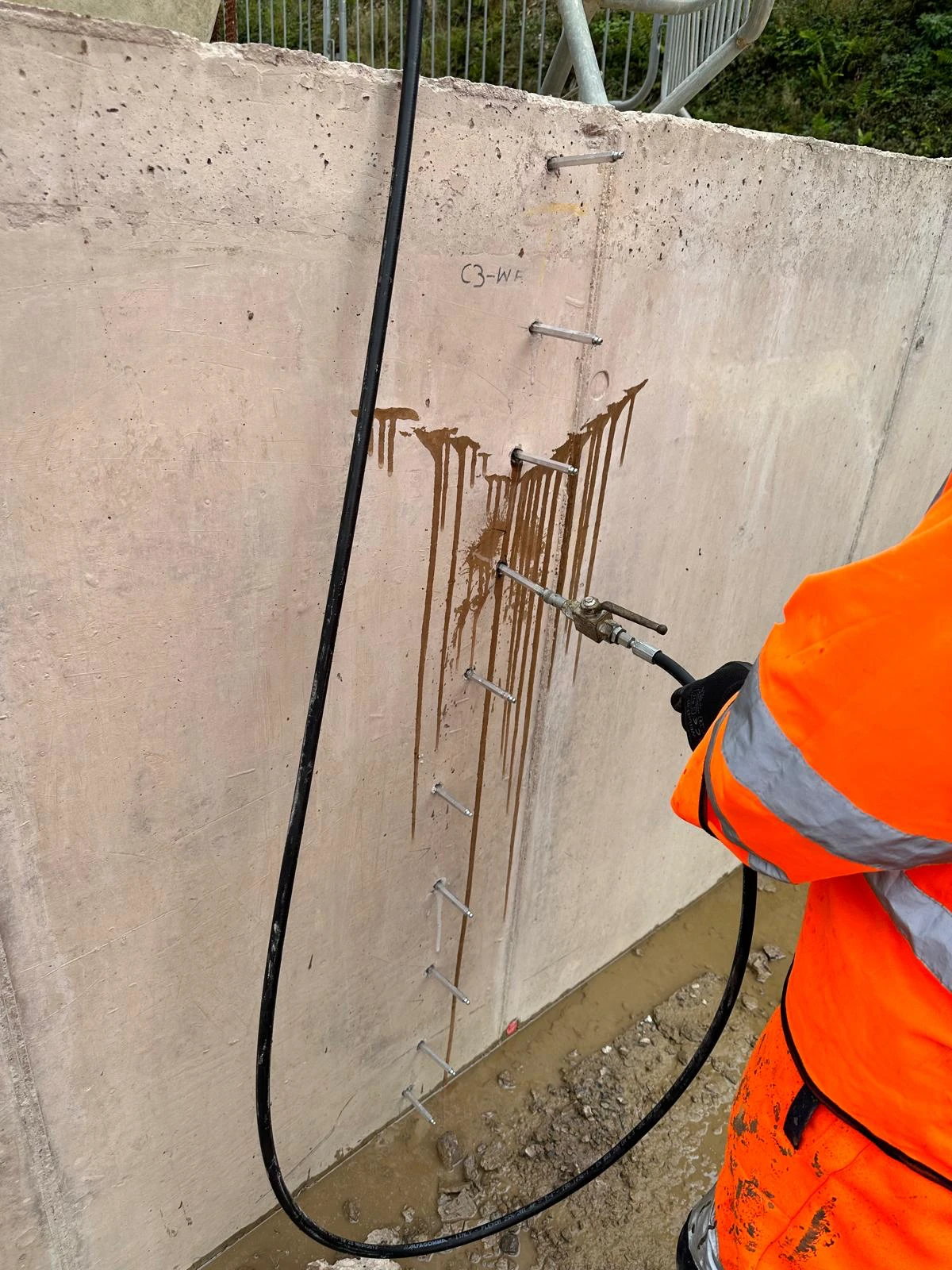
Structural Repairs utilises advanced chemical grouting and resin injection systems to permanently seal leaks and restore the monolithic strength of fractured concrete. We deploy highly specialised polymers directly into the depth of the crack, fundamentally altering the physical properties of the void.
Because we understand material science, we never apply a “one size fits all” approach. Our engineers specify the exact resin chemistry based on the pathology of the failure:
PU is a flexible, water-reactive resin designed specifically to stop active leaks and accommodate slight thermal movement in the concrete. Epoxy is a rigid, high-strength structural adhesive. Epoxy is used to glue cracked concrete back together to restore load-bearing capacity, but it cannot be used if water is actively flowing through the crack.
Yes. Our hydrophobic polyurethane resins are formulated to react instantly upon contact with water. By injecting them under high pressure using specialized mechanical packers, the expanding foam physically forces the water out of the crack and cures within seconds, instantly arresting even the most severe hydrostatic leaks.
No. This is the primary advantage of injection technology. We execute the repair entirely from the negative side (the inside of the building). By drilling into the crack at a 45-degree angle, we intersect the void deep within the wall and inject the resin, completely negating the need for expensive, disruptive external groundworks.
This is known as efflorescence. It occurs when water travels through the masonry and carries natural salts to the surface. When the water evaporates, the salts are left behind. While often cosmetic, it can be a sign of deep water ingress that needs to be addressed through proper drainage and repointing.