Contact Us
If you have a commercial, industrial, infrastructure or heritage structural repair enquiry, contact us now. We will respond within one working day. Please note we do not provide services for domestic properties.

If you have a commercial, industrial, infrastructure or heritage structural repair enquiry, contact us now. We will respond within one working day. Please note we do not provide services for domestic properties.
Business enquiries:
A structural crack in masonry or concrete is never merely a cosmetic defect; it is a physical rupture in the building’s load-bearing geometry. Whether caused by thermal expansion, foundation settlement or excessive dynamic loading, a visible fracture indicates that the material’s tensile capacity has been fundamentally overwhelmed.
Once the masonry envelope is breached, the degradation cycle accelerates rapidly. Continuous water ingress penetrates the structural core, triggering internal freeze-thaw expansion and the subsequent hidden corrosion of embedded wall ties. Simply raking out and repointing the crack with standard mortar is a dangerous, temporary aesthetic fix. It masks the symptom while entirely ignoring the underlying loss of structural continuity.
To permanently restore the integrity of a failing facade, the separated masonry must be mechanically reconnected. Our engineers deploy precision crack stitching methodologies – embedding high-tensile stainless steel helical bars deep within the mortar beds, bonded with advanced, non-shrink structural grouts. This creates a highly resilient reinforcement matrix within the wall, seamlessly transferring and distributing structural loads across the original fracture.
We execute these structural interventions in strict accordance with the masonry defect and assessment frameworks published by the Building Research Establishment (BRE). This ensures your commercial asset regains its full tensile strength and operational safety, arresting further structural movement without the immense capital expenditure of a full facade rebuild.
The most common and dangerous mistake asset managers make is treating structural cracks with cosmetic solutions. Simply raking out a cracked mortar joint and filling it with fresh cement or mastic does nothing to restore the wall’s strength. Because the new mortar has no tensile capacity, the same crack will simply reopen the moment the building experiences minor thermal movement or wind loading.
Leaving a fractured wall unreinforced allows independent movement between the masonry panels. Over time, this localised failure compromises the entire structural envelope, leading to severe weather ingress, dropping arches and eventual wider collapse.
To permanently resolve structural cracking, you must introduce new tensile strength across the fracture zone. Structural Repairs engineers high-performance crack stitching systems using stainless steel helical profiles and advanced Carbon Fibre composites.
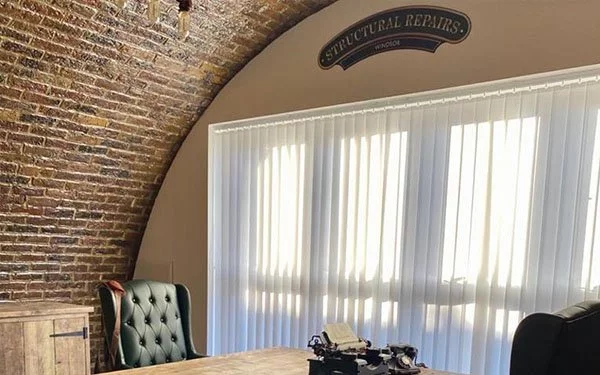
Our confidence in heavy-duty masonry repair is absolute. In fact, our own headquarters is located in restored railway arches. We used our own advanced masonry repair and stitching techniques to secure the brickwork above our heads, ensuring the arches can safely absorb the immense dynamic loads and vibrations of the live rail network running directly over our facility. We literally work beneath the proof of our own engineering.
Helical ties are flexible, stainless steel bars ideal for standard masonry and brickwork, as they allow for natural, microscopic thermal movement while holding the wall together. Carbon fibre is significantly stronger and more rigid, making it the engineered choice for heavily loaded concrete slabs, civil infrastructure, and high-stress structural nodes where movement must be entirely arrested.
No. Crack stitching restores the structural integrity of the wall itself, but it does not fix foundation subsidence. If the crack was caused by active ground movement, we must first stabilise the foundations (via underpinning or resin injection) before we stitch the masonry. Stitching a wall that is still actively sinking will simply force the masonry to crack in a new location.
Structural Repairs offer expert ground stabilisation and underpinning services.
Not at all. The process is rapid and localized. We use specialized, dust-extracted chasing equipment to cut the slots in the mortar beds. There is no need to rebuild the wall, no heavy structural propping required, and the building can remain fully occupied and operational throughout the works.
When engineered correctly and applied after the root cause of movement has ceased, the repair is permanent. The marine-grade stainless steel and carbon fibre composites we use are completely immune to rust and environmental degradation within the masonry.