Contact Us
If you have a commercial, industrial, infrastructure or heritage structural repair enquiry, contact us now. We will respond within one working day. Please note we do not provide services for domestic properties.

If you have a commercial, industrial, infrastructure or heritage structural repair enquiry, contact us now. We will respond within one working day. Please note we do not provide services for domestic properties.
Business enquiries:
Highway bridges and rail viaducts face a perfect storm of structural challenges. Decades of heavy dynamic traffic loading, severe freeze-thaw cycles and the aggressive use of de-icing salts relentlessly degrade concrete and masonry assets. When a bridge deck spalls or a support pier fractures, asset owners face a critical dilemma: execute a highly disruptive repair or risk catastrophic failure.
At Structural Repairs, we provide specialist engineering support to Highway Authorities, rail network operators and Tier 1 Contractors worldwide. We do not apply blind, cosmetic patches. We engineer targeted, low-carbon structural interventions designed to extend the life of the asset while keeping the transport network moving.
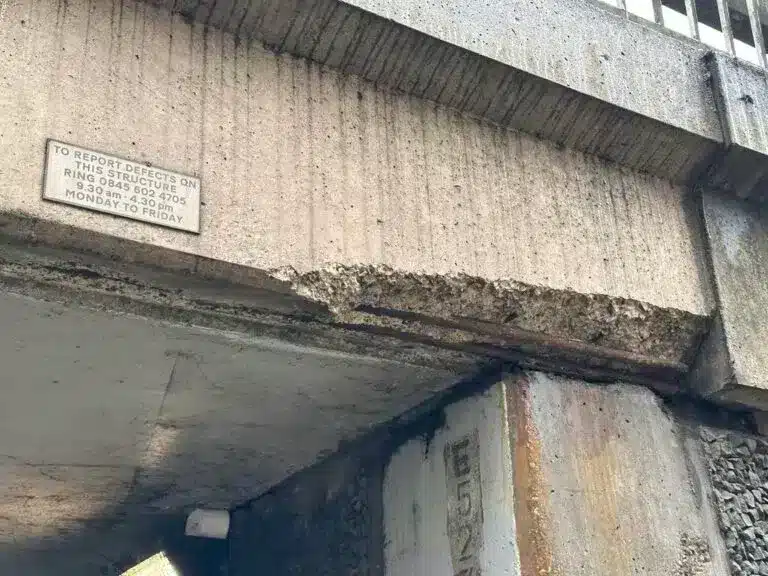
London Bridge in Need of Repair
You cannot engineer a permanent repair without first understanding the hidden pathology of the structure. On ageing bridge networks, the most severe threats – such as chloride-induced corrosion and post-tensioning voids – are entirely invisible from the surface.
Before any breakout or physical repair begins, our in-house engineering teams deploy advanced Non-Destructive Testing (NDT) and structural scanning.
This forensic data dictates the precise repair specification, ensuring you only pay for the exact engineering intervention your bridge requires.
Once the diagnostic data is analysed, our directly employed teams execute the physical remediation. Working in high-speed, live traffic environments requires agility and precision. We use rapid-setting technologies and advanced access platforms to complete critical repairs during tight possession windows or overnight closures, drastically reducing your Traffic Management (TM) costs.
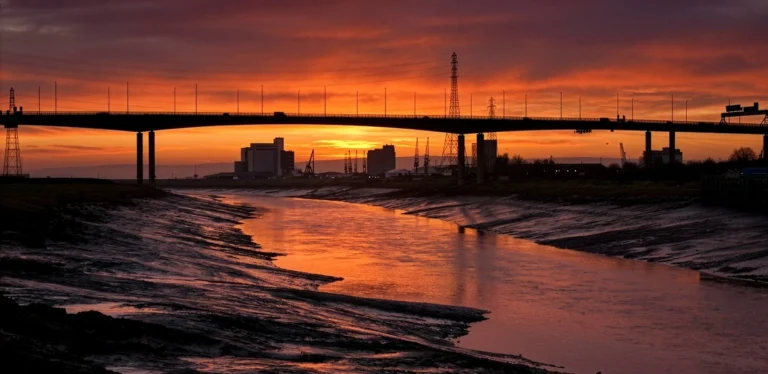
A civil engineering case study detailing the deployment of autonomous robotic crawlers for Ground Penetrating Radar (GPR) and visual bearing inspections on the M5 Avonmouth Bridge. Highlights the acquisition of empirical data to inform preventative concrete repair and bearing replacement for National Highways, while eliminating rope access and traffic disruption.
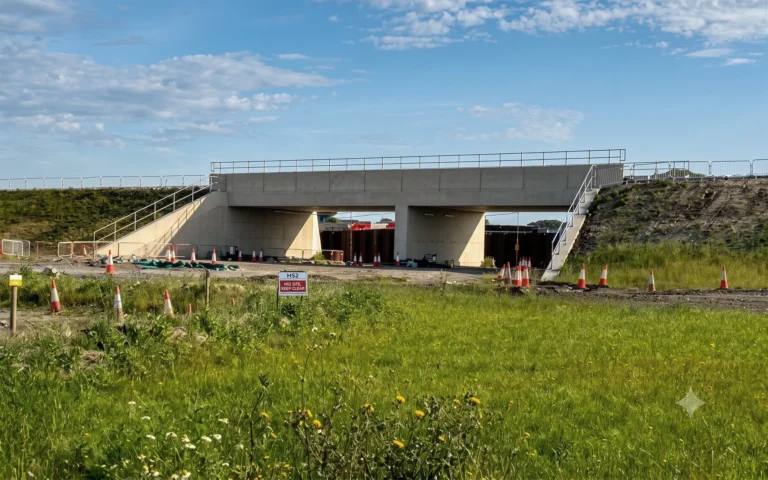
Engineering the Future of the the UK Rail Network High Speed 2 (HS2) represents the most significant upgrade to the UK’s transport infrastructure in a generation. The engineering tolerances required…
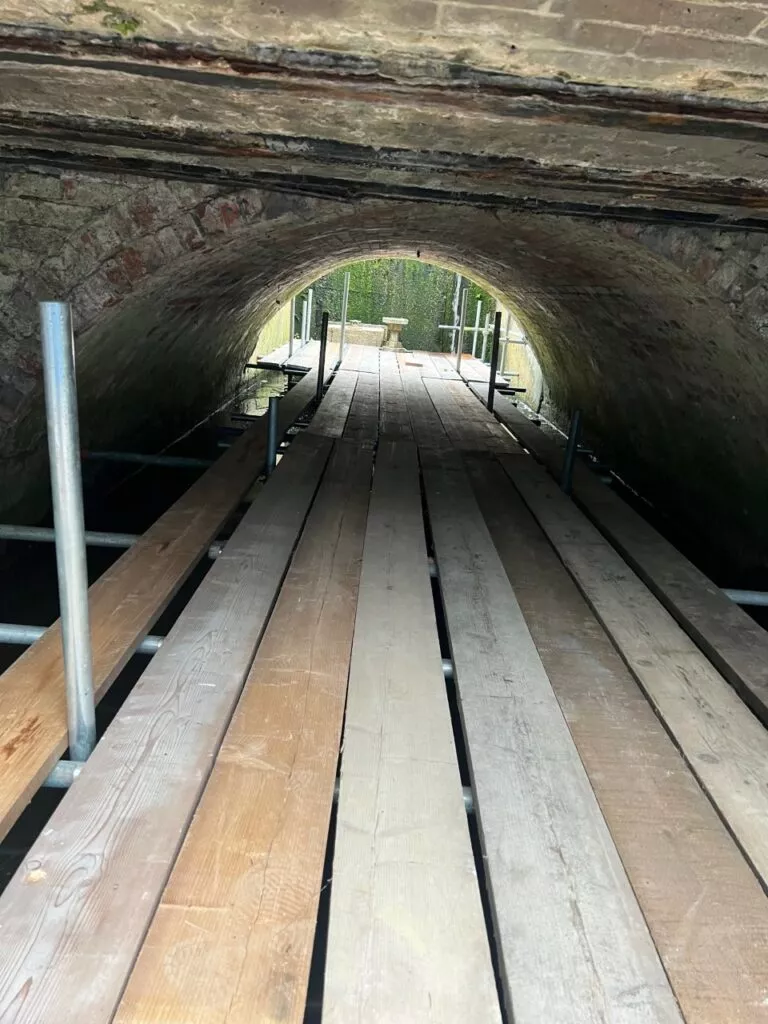
Concrete Scanning Maltbridge Island About The Site: Maltbridge Island is a collection of converted from a 19th Century Mill. Located on a private island, it has fine river views to…
Spalling on concrete bridges is almost entirely driven by reinforcement corrosion. When de-icing salts (chlorides) or carbon dioxide (carbonation) penetrate the porous concrete, they attack the internal steel rebar. As the steel rusts, it expands with immense force. This phenomenon – known as rust jacking – blows the face off the concrete, creating falling debris hazards and compromising the load-bearing integrity of the deck or pier.
We use advanced material science and agile project phasing. Our engineers specify specialist fast-setting structural mortars and resins that achieve full load-bearing strength in as little as two hours. Combined with targeted hydro-demolition, this allows us to cut out, repair and reinstate a section of the bridge deck within a single overnight shift, reopening the lane before the morning rush hour.
Carbon fibre (CFRP) has an exceptional strength-to-weight ratio. When bonded to the underside (tension face) of a bridge beam using structural epoxy, it acts as an external reinforcement tendon. It takes over the tensile load from corroded internal rebar, allowing an ageing bridge to safely support modern, heavier traffic loads without the need to bolt on heavy, rust-prone steel plates.