Contact Us
If you have a commercial, industrial, infrastructure or heritage structural repair enquiry, contact us now. We will respond within one working day. Please note we do not provide services for domestic properties.

If you have a commercial, industrial, infrastructure or heritage structural repair enquiry, contact us now. We will respond within one working day. Please note we do not provide services for domestic properties.
Business enquiries:
Explosive detonations and high-velocity kinetic impacts subject structural frameworks to instantaneous, catastrophic overpressure. Unprotected concrete and masonry will invariably shatter under these extremes, generating lethal fragmentation and initiating progressive building collapse.
Structural Repair Solutions provides definitive engineering interventions to harden critical infrastructure against hostile action. Operating across government estates, global defence organisations, subterranean bunker complexes and high-risk commercial assets, we bridge the gap between theoretical security consultancy and physical structural fortification. Having proudly delivered solutions under the Ministry of Defence’s ‘Preservation of Life’ directive, our systems are engineered to provide absolute protection for military and civilian personnel worldwide.
Our engineering interventions do not merely add a protective facade to a vulnerable asset. By combining forensic diagnostic scanning to pinpoint pre-existing construction flaws with advanced composite reinforcements, we are able to engineer targeted upgrades that render the structure exponentially stronger than its original architectural design.
We do not just protect the baseline state – we fundamentally elevate the load-bearing capacity of the building.
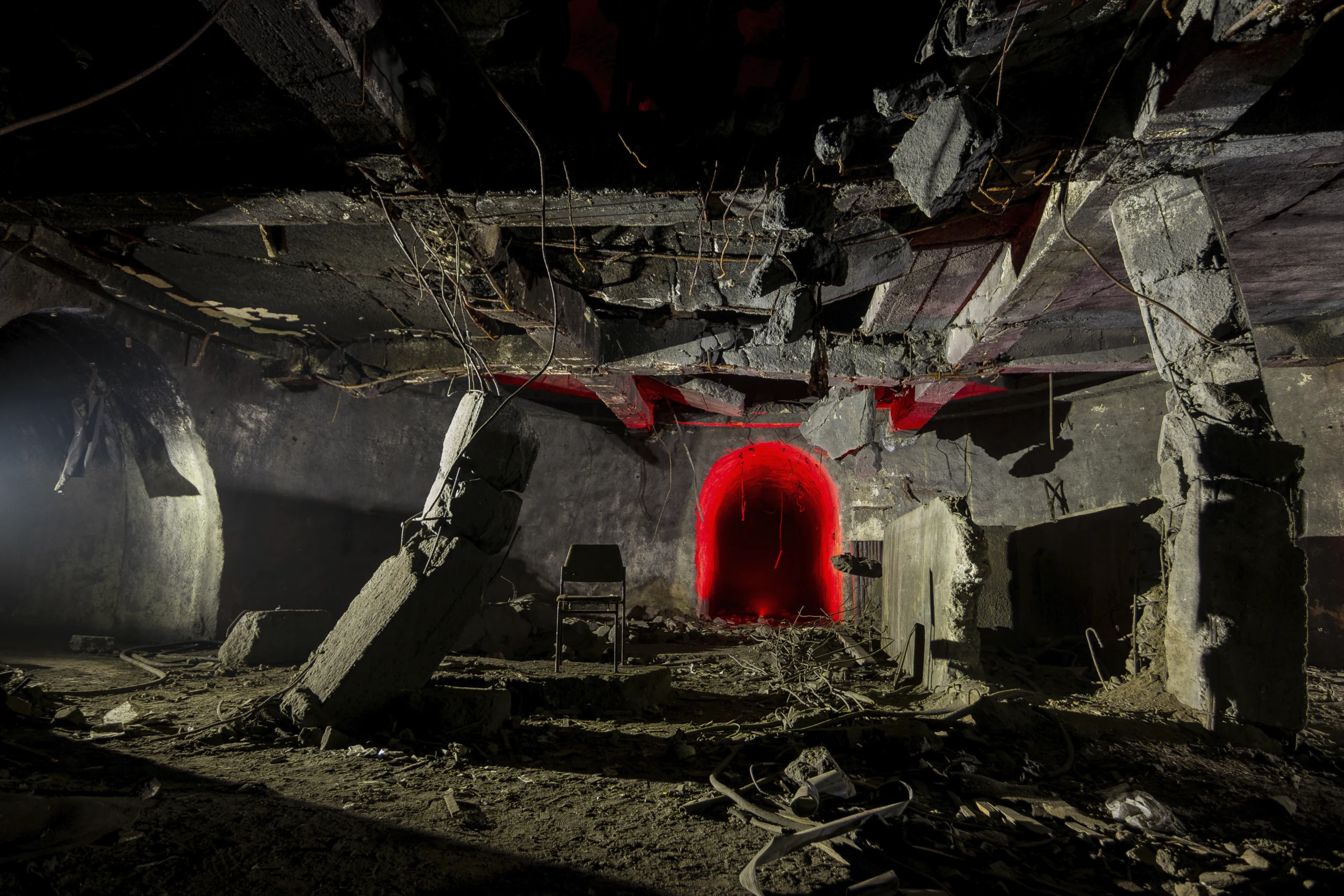
Bunkers at an abandoned Zeljava air base in Croatia – despite not being breached, the bunker walls and ceiling demonstrate catastrophic weakening and fatal spalling.
Protecting an asset from targeted kinetic impact requires materials capable of immense energy dissipation. Standard reinforcement simply cannot arrest sustained, concentrated firepower.
We retroactively upgrade vulnerable structural envelopes using Ultra-High-Performance Concrete (UHPC) overlays and advanced aramid fibre composites to actively resist bullet and missile penetration. By integrating these high-density, energy-absorbing layers into the existing architectural fabric, we drastically upgrade the ballistic resistance of the structure without requiring visually obtrusive external defences.
/
When an explosion occurs, the blast wave itself is often less lethal than the secondary fragmentation of shattered concrete and masonry.
Unprotected concrete is inherently strong under compression but critically weak under tension. As a blast shockwave travels through a concrete slab and hits the internal free face (the inside of the room), it violently reflects back upon itself. This reflected tensile wave instantly exceeds the material’s structural limits. The internal face of the wall shatters, ejecting lethal, high-velocity concrete fragmentation directly into the occupied space – a process known as spalling.
Adjust the kinetic energy slider in this simulation to observe the visualise tensile failure and catastrophic spalling.
Our engineers deploy highly specified Carbon Fibre Reinforced Polymer (CFRP) matrices and elastomeric polyurea coatings to actively contain these explosive forces. This engineered containment completely eliminates deadly concrete spalling and preserves the fundamental load path – preventing the catastrophic progressive collapse of the building in alignment with IStructE dynamic loading principles.
Crucially, these highly engineered systems can be applied retrospectively to existing architecture. Bonded directly to internal walls, load-bearing columns and the underside of critical floor slabs, this lightweight reinforcement dramatically increases the tensile ductility of the host material and exponentially increases resistance against blast overpressure. In the event of a detonation, the structural fabric flexes rather than shatters. This engineered containment completely eliminates deadly concrete spalling and preserves the fundamental load path – preventing the catastrophic progressive collapse of the building.
Explosive spalling occurs when a blast shockwave travels through a concrete wall and reflects off the internal face. This reflected wave creates immense tensile stress, causing the concrete to violently shatter and eject lethal, high-velocity fragmentation into the occupied space.
Carbon Fibre Reinforced Polymer (CFRP) provides immense tensile ductility. When bonded to the internal faces of a structure, it acts as a high-strength containment matrix. During a detonation, the CFRP allows the wall to flex and absorb the overpressure, catching fragmentation and preventing catastrophic shear failure.
Yes. Structural Repairs deploys Ultra-High-Performance Concrete (UHPC) overlays and aramid fibre composites to retroactively upgrade vulnerable structures. These high-density, energy-absorbing layers integrate seamlessly into the existing architecture to resist ballistic and missile penetration.
Due to the sensitive nature of our ballistic and blast mitigation systems, detailed structural specifications and Ministry of Defence operational case studies are strictly controlled.
Submit a secure enquiry to our engineering desk today to request classified technical data and arrange a confidential threat mitigation consultation.