Contact Us
If you have a commercial, industrial, infrastructure or heritage structural repair enquiry, contact us now. We will respond within one working day. Please note we do not provide services for domestic properties.

If you have a commercial, industrial, infrastructure or heritage structural repair enquiry, contact us now. We will respond within one working day. Please note we do not provide services for domestic properties.
Business enquiries:
Visible cracks and surface spalling are only the symptoms; they are rarely the root cause. When assessing the viability of an existing structure, a change of use, or the extent of environmental degradation, visual inspections are fundamentally inadequate. To engineer a permanent repair or safely increase load capacity, you need empirical data on the exact chemical and physical condition of the concrete matrix.
Concrete integrity degrades invisibly. Carbonation gradually neutralises the alkaline protection around steel reinforcement, chlorides from marine environments or de-icing salts penetrate deep into the substrate, and micro-cracking compromises compressive strength long before a structural failure is visible.
Relying on legacy concrete strength or superficial surveys leads to two dangerous outcomes:
If you do not know the exact tensile strength, compressive capacity and chemical pathology of your asset, you cannot design a safe, compliant or cost-effective structural intervention aligned with the technical guidelines published by The Concrete Society.
Structural Repairs operates at the intersection of material science and structural engineering.
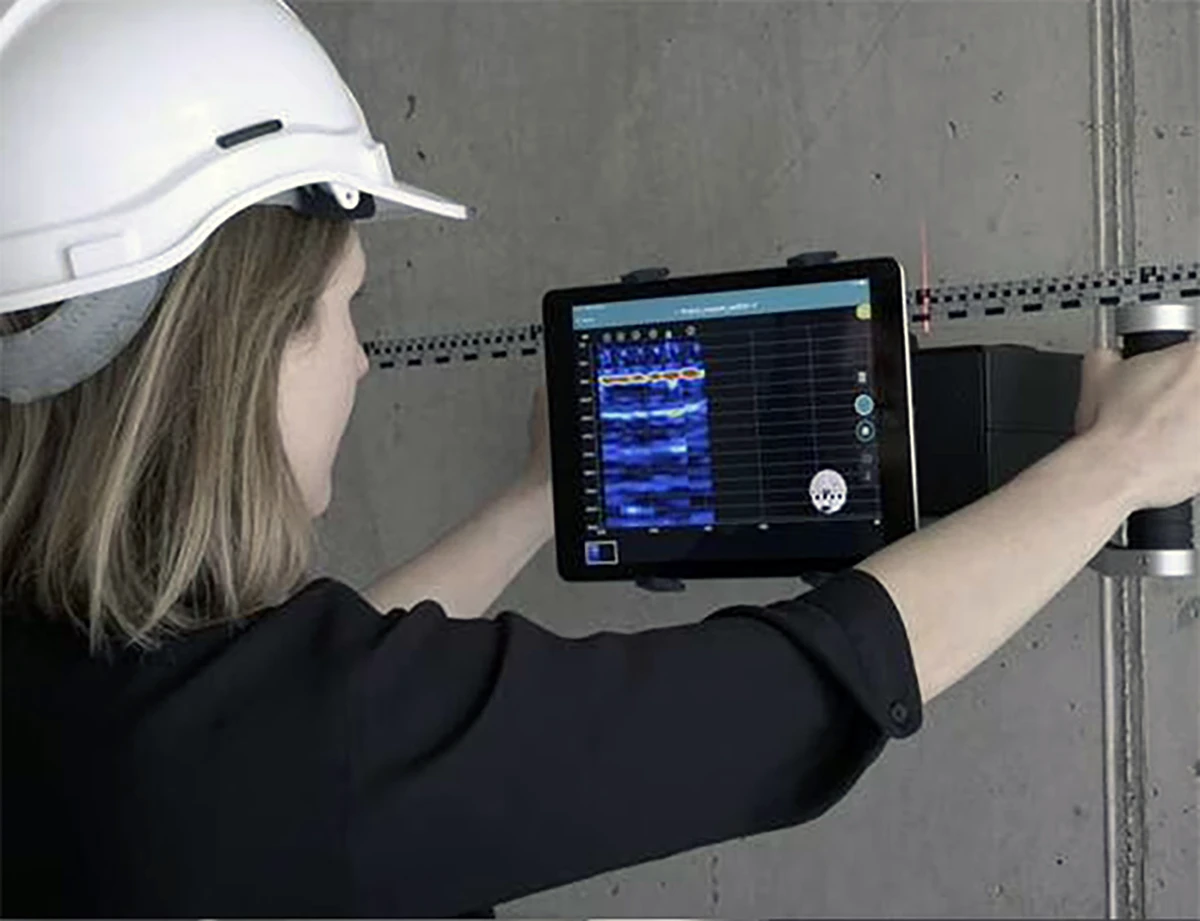
We do not just look at the concrete; we interrogate it. Our technical teams deploy a comprehensive suite of both destructive and non-destructive testing (NDT) methodologies to build a complete diagnostic profile of your asset.
We extract physical core samples for laboratory-controlled compressive strength crushing – executed under strict UKAS accredited conditions – conduct chemical analyses for chloride ingress and carbonation depth and perform digital pull-off testing to verify the substrate’s tensile viability before bonding advanced composites.
Non-destructive testing (like Ground Penetrating Radar, ultrasonic pulse velocity, or Schmidt hammer testing) assesses the concrete integrity without damaging it, making it ideal for large-scale rapid surveys. Destructive testing involves physically removing a small sample of the material (like core extraction) or breaking the surface (like a pull-off test) to yield highly precise, laboratory-verified data. We typically use a combination of both.
The most accurate method to establish concrete integrity is diamond core extraction. We drill and remove cylindrical samples of the concrete, which are then taken to a laboratory and crushed under controlled loads to measure their exact compressive failure point. We also use NDT methods to correlate and map this strength across the wider structure.
A pull-off test measures the tensile strength and surface adhesion of the concrete. We bond a steel disc (dolly) to the surface and use a calibrated digital hydraulic gauge to pull it off, measuring the exact force required to cause the concrete to fail. This is a mandatory prerequisite before applying structural repair mortars or carbon fibre strengthening systems.
Healthy concrete is highly alkaline, which protects the internal steel rebar from rusting. Carbon dioxide (carbonation) and chlorides (salts) lower this alkalinity. Once this chemical attack reaches the depth of the rebar, the steel expands and blows the concrete apart from the inside. Testing for these elements allows us to predict and halt corrosion before structural failure occurs.
We do not simply hand over raw laboratory data. Following the diagnostic programme, our engineers compile a comprehensive structural pathology report. This documentation includes empirical test results, highly accurate spatial mapping and an actionable remediation strategy. Crucially, all data is formatted for seamless integration into your existing Building Information Modelling (BIM) or asset management workflows.
Minimising commercial downtime is a primary objective during any deployment. Our non-destructive testing (NDT) methodologies – including Ground Penetrating Radar and ultrasonic scanning – are silent and entirely non-intrusive. Where physical core extraction is strictly necessary, we deploy low-vibration, dust-controlled diamond drilling equipment, allowing your facility to remain operational throughout the diagnostic phase.
Yes. Our engineering teams hold advanced certifications for confined space entry and deploy specialised equipment for highly complex infrastructure. Whether assessing the chloride ingress of a coastal seawall or mapping the structural integrity of a subterranean utility vault, we have the technical capability to extract definitive diagnostic data from the most hostile commercial environments.