Contact Us
If you have a commercial, industrial, infrastructure or heritage structural repair enquiry, contact us now. We will respond within one working day. Please note we do not provide services for domestic properties.

If you have a commercial, industrial, infrastructure or heritage structural repair enquiry, contact us now. We will respond within one working day. Please note we do not provide services for domestic properties.
Business enquiries:
Embankments and earthworks are the foundational support for our transport and utility networks. However, they are under constant threat from environmental factors. Heavy rainfall, poor drainage and cyclical weather patterns saturate the soil, leading to increased pore water pressure and a loss of shear strength. When an embankment begins to move, it does not just threaten the landscape; it threatens the safety and continuity of the rail lines, roadways and pipelines situated above and below it.
Ignoring a “minor” slip or a leaning retaining wall is a dangerous gamble. Once soil movement begins, the internal geometry of the slope is compromised. Small fissures allow more water to enter the embankment, accelerating the rate of failure.
Standard landscaping solutions or un-engineered “patching” of retaining walls fail because they do not address the deep-seated slip plane. If you do not anchor the unstable mass to competent ground, the weight of the moving earth will eventually overcome any surface-level barrier. For infrastructure managers, a single landslide can lead to millions in emergency repair costs, operational downtime and potential legal liability.
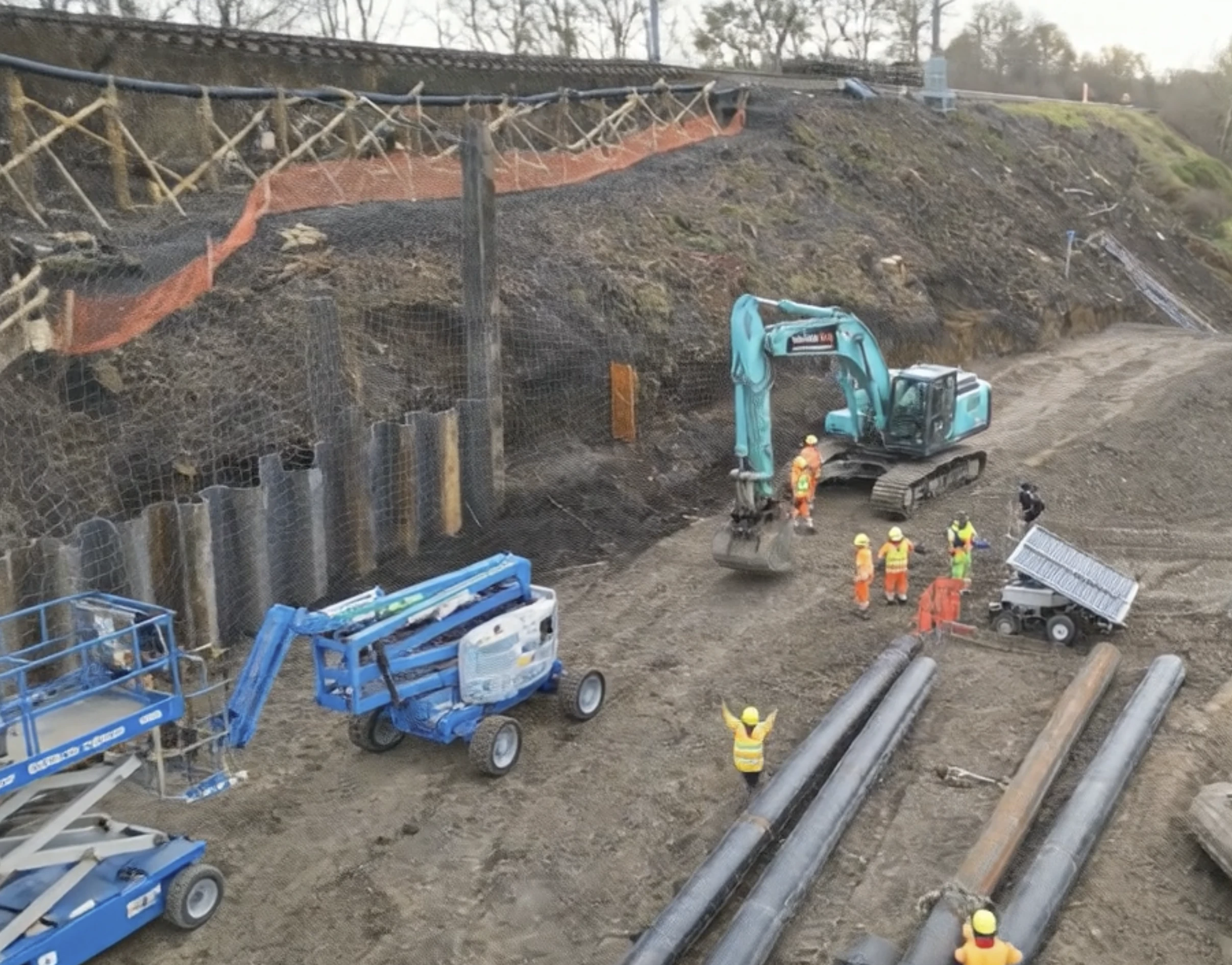
Structural Repairs provides comprehensive geotechnical engineering to arrest slope movement and secure critical infrastructure. We do not just look at the surface. We interrogate the geology to design a permanent stabilisation strategy.
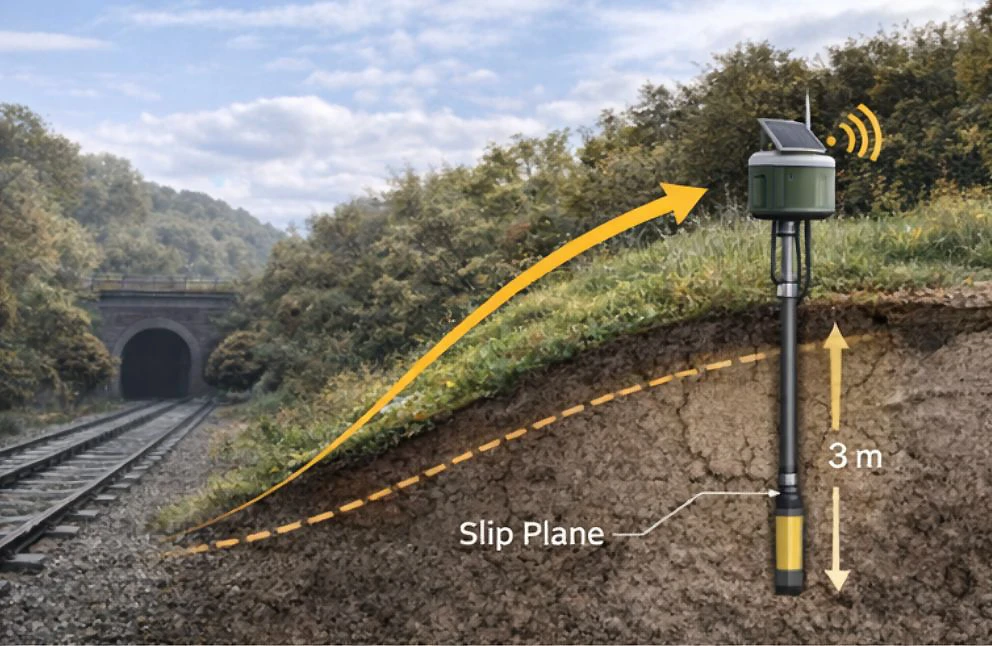
Protecting critical infrastructure requires proactive data. Before deploying structural interventions, Structural Repairs uses advanced remote telemetry to continuously monitor subterranean ground movement and identify exact failure zones.
As illustrated, our proprietary monitoring units are engineered to track micro-displacements deep within the soil profile:
This precise data dictates our targeted stabilization strategy, ensuring interventions are engineered strictly to the active threat.
The most common indicators include “tension cracks” appearing at the top of the slope, trees or fence posts that start to lean downhill and water regularly bubbling up at the bottom of the embankment (the “toe”). If you notice cracks appearing in the road or rail track at the top, the slip is already in an advanced state.
Soil nailing is a technique where we drill long, steel reinforcement bars into the earth at a slightly downward angle. We then grout these bars into the soil. Once the grout sets, these “nails” act like internal structural anchors that bind the soil mass together and prevent it from sliding down the slip plane.
In many cases, yes. While we may need to clear specific areas for drilling equipment, we aim to preserve as much natural root structure as possible. We often use high-strength mesh systems that sit over the ground, allowing grass and plants to grow through the mesh to provide a “green” finish that further stabilizes the surface.
If the wall is structurally sound but leaning due to earth pressure, we can often save it by installing ground anchors or “deadman” anchors. These pass through the wall and deep into the soil behind it to pull the wall back and lock it in place. We also improve the drainage behind the wall to prevent future pressure build-up.