Contact Us
If you have a commercial, industrial, infrastructure or heritage structural repair enquiry, contact us now. We will respond within one working day. Please note we do not provide services for domestic properties.

If you have a commercial, industrial, infrastructure or heritage structural repair enquiry, contact us now. We will respond within one working day. Please note we do not provide services for domestic properties.
Business enquiries:
Bridges and viaducts are subject to the most intense structural demands of any civil asset. Constant dynamic loading from increasing traffic volumes, combined with relentless exposure to de-icing salts and moisture, leads to rapid structural degradation. When the internal steel reinforcement of a bridge deck or pier begins to corrode, the bridge loses its design strength.
Traditionally, this meant expensive, long-term closures for heavy-duty concrete reconstruction or the installation of bulky steel plates.
For decades, the standard method for bridge strengthening involved bolting heavy steel plates to the underside of the structure. While effective at adding tensile strength, steel plates introduce significant engineering challenges. They add massive dead-weight to an already stressed structure, they are difficult to install in restricted access areas and they require a lifetime of expensive maintenance to prevent rust. Furthermore, drilling into a bridge deck to install heavy mechanical anchors can inadvertently damage the very rebar you are trying to save.
Structural Repairs specialises in the design and application of Carbon Fibre Reinforced Polymer (CFRP) products specifically engineered for bridge restoration. Our advanced composite systems provide an aerospace-grade alternative to traditional steel, allowing for rapid, high-strength reinforcement with zero risk of corrosion.
We deploy a range of bespoke carbon fibre bridge products to reinstate shear and flexural strength while minimising the impact on the transport network.
We engineer the precise solution for the root cause, ensuring verifiable compliance with the BS EN 1504 concrete repair standards and the National Highways Design Manual for Roads and Bridges (DMRB).
CFRP provides up to ten times the tensile strength of steel at a fraction of the weight. Crucially for highway infrastructure, it is completely immune to chloride-induced corrosion from de-icing salts, making it a permanent structural intervention.
Yes. By applying high-modulus CFRP to the tension zones of the deck and support beams, we can significantly enhance both flexural and shear capacity. This allows degraded or historic bridges to safely accommodate modern, heavier traffic loads without requiring disruptive reconstruction.
While bare epoxy can degrade under prolonged UV exposure, our bridge reinforcement systems are fully protected. We finish all surface-bonded composites with specialist UV-resistant aliphatic coatings or embed the carbon fibre directly into the deck (NSM), guaranteeing permanent environmental protection.
Surface preparation is the most critical phase of the process. We utilise dust-extracted mechanical grinding or grit blasting to achieve a high-quality substrate profile. We then conduct pull-off tests to verify the bond strength of the structural epoxy. Our engineers ensure that the resin bond is stronger than the concrete itself, guaranteeing that the load is successfully transferred to the carbon fibre.
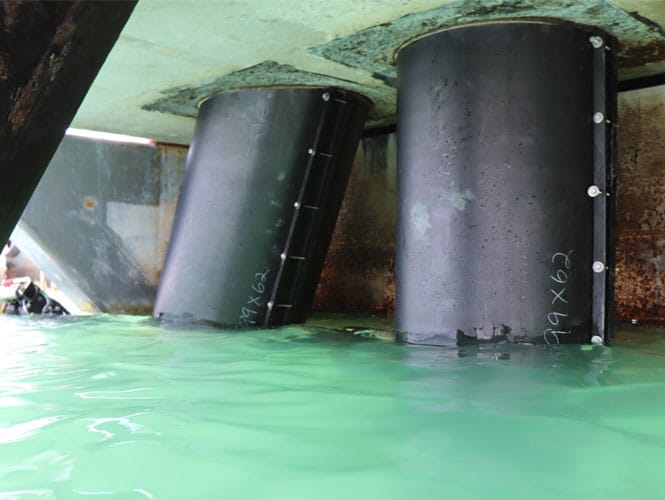
Carbon fibre-based bridge reinforcement products are entirely immune to rust and, with appropriate coatings, UV damage