Contact Us
If you have a commercial, industrial, infrastructure or heritage structural repair enquiry, contact us now. We will respond within one working day. Please note we do not provide services for domestic properties.

If you have a commercial, industrial, infrastructure or heritage structural repair enquiry, contact us now. We will respond within one working day. Please note we do not provide services for domestic properties.
Business enquiries:
Historic and listed buildings are fragile, complex ecosystems. Over centuries, they settle, materials degrade, and original construction methods fail under modern environmental stresses. When a Grade I or II listed structure exhibits deep masonry cracking, bowed walls, or foundation movement, you cannot simply apply modern construction methods to fix it. Securing a heritage asset requires a profound understanding of historical material science combined with advanced, non-disruptive structural engineering.
The greatest threat to a historic building is rarely the passage of time; it is the intervention of an unqualified contractor. Modern building materials are fundamentally incompatible with historical structures.
If a contractor repoints a 400-year-old soft brick wall using modern Portland cement, they seal the masonry. The building can no longer “breathe,” trapping moisture inside the wall. When winter arrives, that trapped moisture freezes and expands, physically shattering the historic bricks and triggering accelerated structural collapse. Furthermore, installing heavy steel beams or invasive modern propping often destroys the architectural integrity of the building, instantly violating strict conservation laws and drawing severe penalties from heritage authorities.
Structural Repairs operates as a specialist partner to heritage architects, estate managers, and conservation officers. We practice “Sympathetic Engineering”—the science of restoring structural load capacity without altering the aesthetic or historical integrity of the asset.
As a specialist engineering contractor delivering integrated concrete preservation, strengthening and reinforcement, we do not merely supply materials. We manage the entire lifecycle of the restoration—from structural analysis through application—ensuring single-source accountability on sensitive heritage sites.
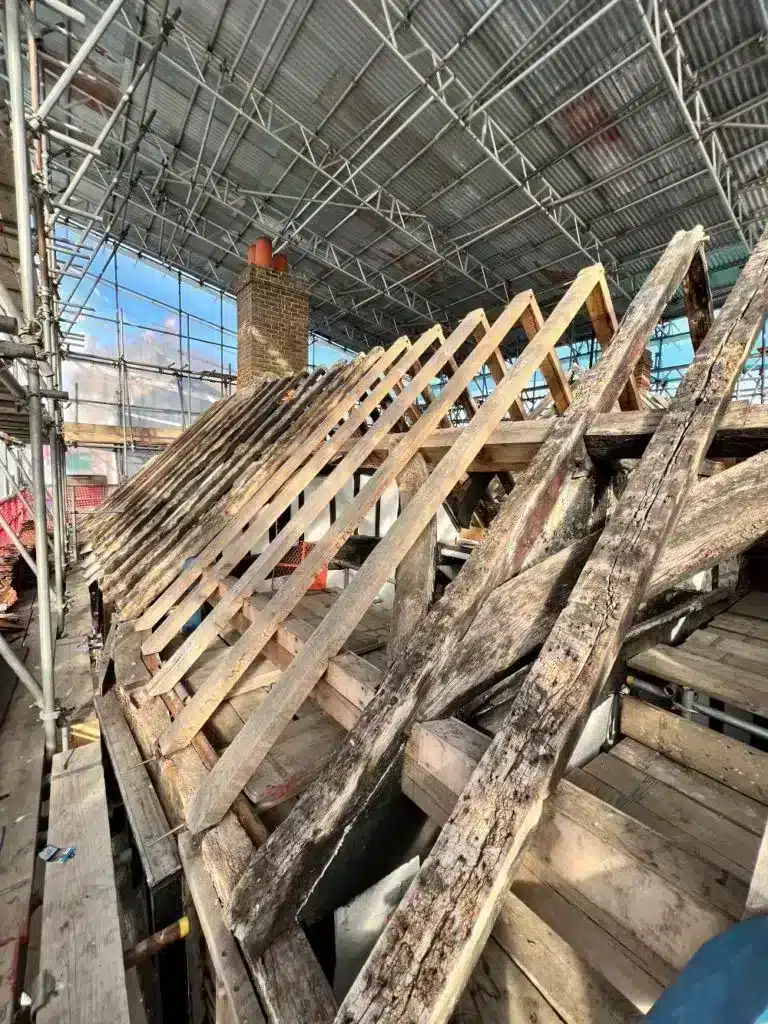
Our commitment to heritage conservation is visible in the physical landscape around us. Just around the corner from our headquarters stands The Cockpit, a Grade-listed historic asset that serves as our flagship restoration project. We engineered the complete structural rescue of this building, deploying the exact sympathetic methodologies we offer our clients. It stands as a permanent, living case study, proving that advanced structural interventions can seamlessly preserve historical fabric while securing the building for the next century.
Sympathetic structural repair is the process of restoring a building’s load-bearing capacity using methods and materials that do not alter its historical aesthetic or damage its original fabric. This often involves invisible interventions, such as embedding low-profile carbon fibre or custom-matching breathable lime mortars.
Modern Portland cement is rigid and impermeable. Historic buildings (constructed with lime mortar) need to flex slightly and allow moisture to evaporate through the mortar joints. Cement traps this moisture, forcing it into the bricks themselves, leading to freeze-thaw damage and catastrophic spalling.
Yes. We extract samples of your building’s original mortar and analyze its aggregate composition and binder ratio. We then custom-blend a breathable, lime-based structural mortar that perfectly matches the historical mix in both physical performance and visual aesthetic.