Contact Us
If you have a commercial, industrial, infrastructure or heritage structural repair enquiry, contact us now. We will respond within one working day. Please note we do not provide services for domestic properties.

If you have a commercial, industrial, infrastructure or heritage structural repair enquiry, contact us now. We will respond within one working day. Please note we do not provide services for domestic properties.
Business enquiries:
Traditional piling methods often present a logistical nightmare for urban construction and structural remediation. Heavy percussion piling rigs are loud, cause massive ground vibration and require vast amounts of space. When you are working on a tight residential site, a restricted commercial basement or near sensitive heritage assets, the risk of vibration damage to neighboring structures is a critical liability. You need a foundation solution that provides immense load bearing capacity without the destructive footprint of traditional methods.
Relying on driven or bored piles in restricted areas leads to immediate project friction. The noise and vibration can trigger structural complaints from neighbors or even cause movement in the very building you are trying to save. Furthermore, the massive amount of spoil generated by bored piling creates a significant waste management cost and a mess that is often unacceptable in a live commercial or residential environment. If the ground conditions are poor and access is tight, standard foundation methods are often physically impossible to deploy.
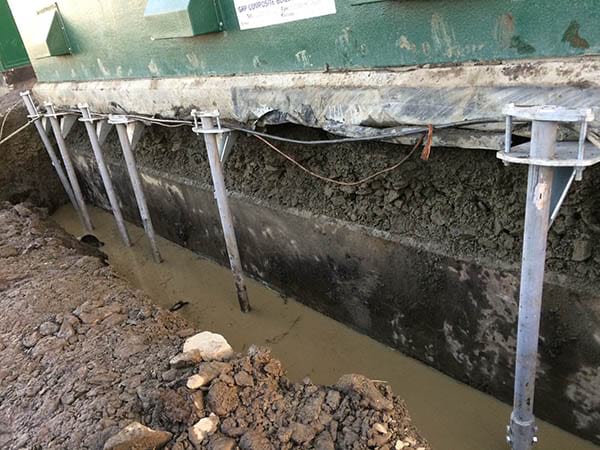
Structural Repairs utilizes advanced Screw Piling (also known as Helical Piling) to provide a rapid, clean and low vibration foundation alternative. Our screw piles are high strength steel shafts with helical plates that are literally “screwed” into the ground using hydraulic torque motors.
This is an engineered displacement system. As the pile rotates it displaces the soil rather than removing it, meaning there is zero spoil to clear away. It is the surgical choice for modern foundation engineering.
A screw pile is a hollow or solid steel shaft with one or more helical (screw-like) plates welded to the bottom. It is wound into the ground using a hydraulic motor. Once it reaches a specific depth and torque, it acts as a permanent, high-capacity anchor for the building’s foundations
Yes, they are exceptionally effective for underpinning. We install the piles alongside the existing foundation and then use heavy-duty steel brackets to transfer the weight of the building onto the new piles. Because the installation is vibration-free, it is much safer for a settling building than traditional methods.
The depth depends entirely on the soil conditions and the load requirements of the building. We screw the piles down until they reach a soil strata (like dense gravel or stiff clay) that provides the necessary resistance. This can be anywhere from a few meters to over 20 meters deep.
They are one of the most sustainable foundation options available. Because they are made of steel, they can be unscrewed and recycled if a temporary building is removed. Furthermore, because there is no soil excavation and no wet concrete involved, the carbon footprint and site impact are significantly lower than traditional methods.