Contact Us
If you have a commercial, industrial, infrastructure or heritage structural repair enquiry, contact us now. We will respond within one working day. Please note we do not provide services for domestic properties.

If you have a commercial, industrial, infrastructure or heritage structural repair enquiry, contact us now. We will respond within one working day. Please note we do not provide services for domestic properties.
Business enquiries:
Railway arches and heavy industrial masonry are the workhorses of our urban infrastructure. These structures endure extreme environmental stress, including constant dynamic vibration from rail traffic, water ingress from failing deck membranes and the natural decay of historic lime mortars. When the brickwork begins to spall, joints wash out or the arch itself shows signs of deformation, the structural safety of the entire asset is at risk.
Standard masonry contractors often approach railway arches as a cosmetic repointing task. This is a critical mistake. If you apply modern, rigid cement mortars to historic brick arches, you prevent the structure from breathing and flexing. This traps moisture behind the face of the brick, causing the masonry to shatter under freeze-thaw cycles.
Furthermore, simply pointing the surface does nothing to address deep-seated voids or internal “ring separation” within the arch. Without restoring the monolithic integrity of the masonry, the arch cannot safely distribute the massive dynamic loads passing over it every day. You need an integrated structural engineering contractor who understands the physics of the arch as well as the chemistry of the mortar.
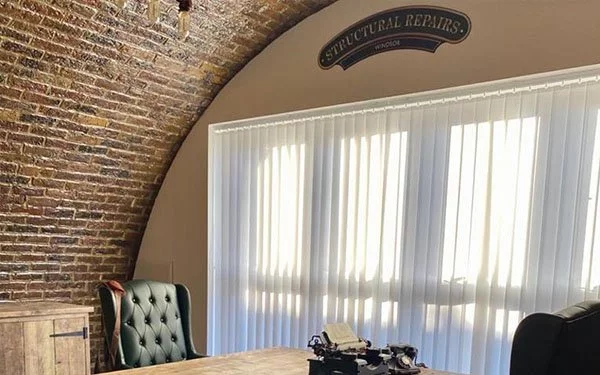
At Structural Repairs, we do more than just talk about masonry restoration. We live it. Our own headquarters is located within a series of restored railway arches. We used our proprietary masonry consolidation and brickwork reinstatement techniques to secure our own facility.
We work every day beneath the proof of our expertise, surrounded by the brickwork we have stabilised to withstand the relentless vibrations of the live rail network running directly above us.
Historic arches are built in multiple layers or “rings” of brickwork. Over time, vibration and moisture can cause the mortar between these layers to fail, allowing the rings to move independently. This significantly weakens the arch. We fix this by injecting structural grouts to bond the rings back together.
Historic bricks are softer and more porous than modern ones. Lime mortar is also soft and breathable, meaning it allows the building to move slightly and moisture to escape. If you use hard Portland cement, the bricks cannot move or breathe, which leads to the bricks cracking and spalling while the rigid cement stays intact.
This is one of our core specialities. By using advanced non-destructive testing (NDT), rope access and low-pressure injection systems, we can often strengthen and restore the masonry from the underside (the soffit) while the rail network continues to operate safely above.
This is known as efflorescence. It occurs when water travels through the masonry and carries natural salts to the surface. When the water evaporates, the salts are left behind. While often cosmetic, heavy efflorescence can be a sign of deep water ingress that needs to be addressed through proper structural drainage and lime repointing.