Contact Us
If you have a commercial, industrial, infrastructure or heritage structural repair enquiry, contact us now. We will respond within one working day. Please note we do not provide services for domestic properties.

If you have a commercial, industrial, infrastructure or heritage structural repair enquiry, contact us now. We will respond within one working day. Please note we do not provide services for domestic properties.
Business enquiries:
Subterranean concrete structures underpin the modern urban and industrial landscape. From deep station boxes to basements, tunnels and transfer slabs, these unseen elements work under immense pressure and must endure for decades with little direct contact or visibility. Yet maintaining subterranean concrete can be one of the most complex tasks faced by asset managers and engineers. The Battersea Power Station redevelopment and the Northern Line Extension (NLE) offer powerful lessons in both the sophistication required to build below ground and the long-term challenges involved in maintaining such construction.
At Battersea the new Underground station, designed by Grimshaw Architects and engineered by Buro Happold with structural input from Robert Bird Group, is encased in a substantial subterranean concrete station box. This structure carries not only the transport infrastructure but also the weight of Electric Boulevard, the over-site development designed by Foster + Partners and Gehry Partners. The roof of the station box acts as a major transfer slab, distributing building loads from above while remaining concealed beneath streetscape, commercial space and residential towers.
This environment sets out clearly the challenges inherent in long-term subterranean concrete maintenance.
The most persistent hazard in managing subterranean concrete is the severe restriction of access. Once built over, the structural surfaces become enclosed behind cladding, backfill or services. The underside of roof slabs are often crowded with mechanical and electrical equipment, leaving minimal space for traditional inspection. Large areas of the walls lie behind architectural finishes or retained earth. As a result, defects such as cracking, delamination or water ingress can remain undetected until they become advanced.
For managers of industrial or commercial estates, this scenario is familiar. Basements become congested with plant. Old service corridors become inaccessible. Records of reinforcement layout may be incomplete. Without adequate inspection routes, hidden deterioration can progress unchecked. Subterranean concrete that appears solid and secure at the surface may in fact be undergoing progressive damage deep within its structure.
Water ingress is one of the most significant risks to subterranean concrete. Hydrostatic pressure acts continuously on below-ground walls and slabs. Any weakness in waterproofing, be it at joints, membranes or service penetrations, can allow water to enter. Once ingress occurs in confined or hidden areas it may compromise reinforcement, promote chemical attack or cause surface spalling.
At Battersea, near the Thames and intersected by major utilities, water management was a critical part of the engineering strategy. Teams from Buro Happold and Robert Bird Group incorporated sophisticated waterproofing and drainage measures. Even so, no waterproofing system is permanent and long-term monitoring remains essential. In older estates where waterproofing was less advanced or where records are missing, the risk is even greater.
Subterranean concrete is subject to unique movement patterns created by soil interaction, ground settlement and changes in load from above-ground structures. At Battersea the subterranean station box supports major over-site development, meaning the concrete experiences complex load paths and long-term creep effects. The engineering teams had to plan for replacement of the station box at the end of its design life, an unusually forward-thinking provision that acknowledges the difficulty of maintaining stressed concrete deep below ground.
Many older commercial or industrial basements and substructures lack such provisions. They may not include expansion joints, monitoring corridors or access panels. Movements can cause progressive cracking and reinforcement corrosion which remain hidden until they become severe.
The challenges of restricted access, water ingress and concealed deterioration mean non-destructive investigation (NDI) is essential for subterranean concrete maintenance. Structural Repairs specialise in advanced scanning technologies that allow asset managers to obtain accurate internal data without intrusive works.
Their capabilities include:
These techniques are invaluable in complex underground assets like the Battersea station box and equally applicable to older basements, service tunnels and industrial substructures. Non-destructive scanning provides clarity where visual inspection is impossible and minimises the need for disruptive openings or invasive testing.
Not all subterranean concrete structures benefit from the high level of foresight seen at Battersea. Many commercial and industrial estates were built decades ago using now outdated details or incomplete waterproofing. Access may be limited or nonexistent. Reinforcement layouts may be undocumented. In such cases Structural Repairs provide crucial insight by identifying structural deficiencies and mapping latent defects while maintaining operational continuity.
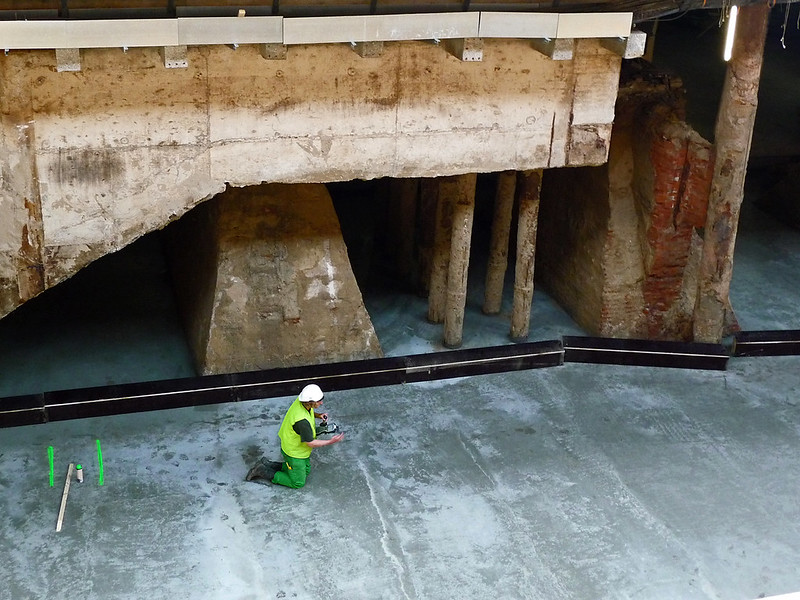
Where deterioration is found they can design and execute targeted repair programmes that minimise disruption. This may include resin injection for crack stabilisation, concrete repairs, waterproofing reinstatement or strengthening works. Their experience in tight, safety-critical and restricted-access environments ensures that even difficult subterranean assets can be maintained to modern standards.
For estate managers and engineers responsible for large-scale developments, subterranean concrete often represents a silent risk. It supports vital infrastructure yet can be the hardest structure to inspect or repair. Battersea demonstrates the complexity of modern subterranean construction and the long-term planning required to manage it.
With advanced scanning and non-destructive investigative techniques Structural Repairs provide the tools needed to maintain subterranean concrete safely, efficiently and with minimal disruption. Whether the original design provided generous access and future-proofing or whether no such provisions were made, accurate diagnosis and well-planned repair remain essential to preserving the integrity of subterranean structures over the long term.