Contact Us
If you have a commercial, industrial, infrastructure or heritage structural repair enquiry, contact us now. We will respond within one working day. Please note we do not provide services for domestic properties.

If you have a commercial, industrial, infrastructure or heritage structural repair enquiry, contact us now. We will respond within one working day. Please note we do not provide services for domestic properties.
Business enquiries:
The Kerch Bridge has got to be one of the great modern test cases for both bridge construction and preservation.
Love it or hate it, the fact that the 19Km structure has never been out of service despite the ingenious and repeated attacks upon it stands as testament to the phenomenal strength and durability of well-engineered concrete.
But, over the past few years, massive civil infrastructure assets like the Kerch Bridge – with its multi-kilometre marine spans – have been subjected to some of the most extreme kinetic stress tests imaginable. We have witnessed major structures suffer repeated attacks, including surface-level vehicle bombs, lateral strikes from unmanned marine vessels, and underwater explosives.
As structural engineers, we look at these events through a strictly forensic lens. Leaving the geopolitics aside, the survival and failure mechanisms of these mega-structures provide invaluable data on how reinforced concrete and steel behave under extreme blast loads and kinetic shock.
Here is a structural breakdown of three distinct kinetic events commonly seen in these extreme environments, and the engineering lessons we can apply to domestic civil infrastructure.
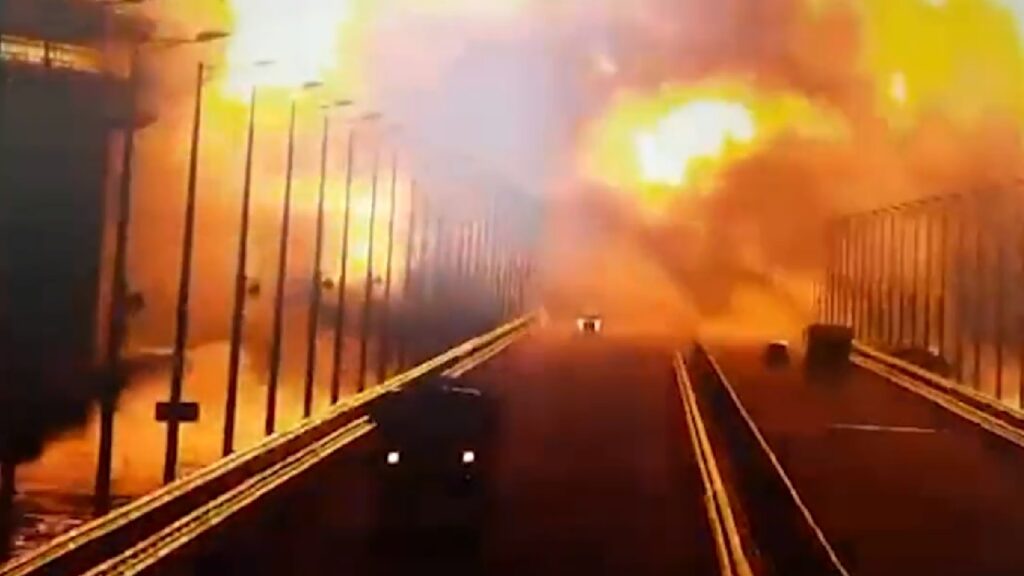
Bridge piers are engineered to carry immense vertical (axial) loads down into the bedrock, alongside a calculated allowance for lateral movement from wind and tides. They are not designed to absorb focused, high-speed lateral kinetic impacts.
When a pier is struck laterally with such force, it is subjected to massive shear stress. If the concrete columns shear, they lose their ability to transfer the weight of the deck above, leading to catastrophic, progressive collapse.
Bridge piers across the UK highway and rail network face their own lateral threats, primarily from vehicle impacts, derailments, and severe river scour or ship collisions. If a domestic concrete column suffers shear damage but remains standing, it must be rapidly confined to prevent the concrete core from bursting outwards under the axial load. We utilise Carbon Fibre (CFRP) wrapping. By binding the damaged pier in layers of aerospace-grade composite fabric, we instantly restore immense “hoop strength” and ductility, reinstating the load-carrying capacity of the column without having to rebuild it from the ground up.
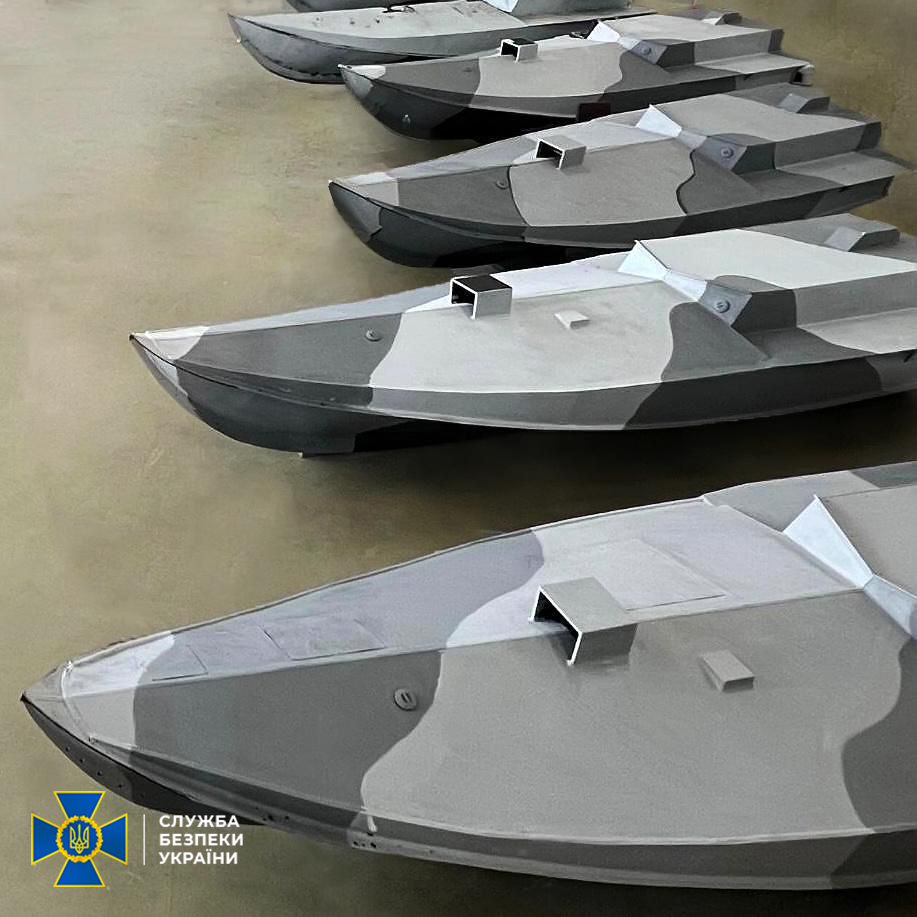
Sea Babies – unmanned Ukraininan aquatic drones.
Image from Ssu.gov.ua, CC BY 4.0
When direct destruction of a mega-structure proves exceptionally difficult, attackers often shift focus to the surrounding logistics networks.
Why? Because bringing down a multi-pier marine bridge permanently is a monumental task. Mega-structures like this are built with massive “engineered redundancy.” This means that even if one element fails, the load forces automatically redistribute to adjacent structural members, preventing total collapse. The structure bends, cracks, and drops sections, but its core spine often survives.
If a critical UK bridge or marine asset suffers a major kinetic impact – whether from an industrial accident, a vessel strike, or a terror event – the required engineering response mirrors the survival mechanics observed in extreme stress tests:
Extreme engineering events prove that concrete and steel, when combined with rapid, highly-engineered remediation, can survive almost anything. But you have to have the right diagnostics, the right composites, and the right engineering team ready to mobilise.