Contact Us
If you have a commercial, industrial, infrastructure or heritage structural repair enquiry, contact us now. We will respond within one working day. Please note we do not provide services for domestic properties.

If you have a commercial, industrial, infrastructure or heritage structural repair enquiry, contact us now. We will respond within one working day. Please note we do not provide services for domestic properties.
Business enquiries:
You might have missed it but the 2026 US/Mexico/Canada World Cup is now in full swing. So we thought we’d dust out this old beauty from the dying days of lockdown.
We’re structural people, so our attention inevitably falls on the spectacular venues hosting the tournament. However, beneath the architectural glamour lies a world of extreme structural engineering, vast capital expenditure and relentless material science. Despite the controversies and the politics, crowds are packing themselves in to giant stadia across central and north America.
And what stadia they are.
Building a modern mega-stadium is an exercise in pushing concrete and steel to their absolute limits. Maintaining them is an even greater challenge. From surviving aggressive coastal winds to absorbing the immense dynamic loads of retractable roofs, these structures require constant, highly specialised asset management.
Here are the ten most expensive stadiums in the world, adjusted for inflation, alongside a deep dive into the architects who designed them and the structural engineering challenges inherent in keeping them standing.
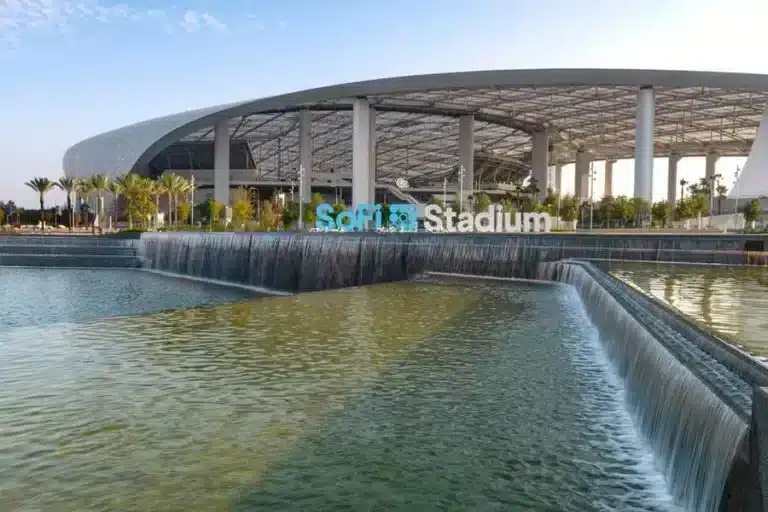
At a staggering cost of $5.5 billion, SoFi Stadium – designed by global architectural firm HKS – is an engineering behemoth constructed directly on an active seismic fault zone. To mitigate catastrophic tectonic forces, the entire concrete seating bowl is structurally isolated from the surrounding ground, sitting on a massive mechanically stabilised earth (MSE) wall system.
The foundational engineering required trenches up to 100 feet deep, creating profound challenges regarding groundwater ingress and hydrostatic pressure. Engineers must constantly monitor the bespoke seismic movement joints, which allow the structure to flex independently, ensuring the vast volume of reinforced concrete does not suffer shear failure during an earthquake. Maintaining the integrity of this isolated concrete basin requires continuous, highly specialised seismic strengthening and monitoring.
Designed by HOK, MetLife Stadium relies on a vast precast concrete seating bowl wrapped in a steel exoskeleton. Located in New Jersey, the primary structural antagonist is the severe freeze-thaw cycle of the North American winter. The sheer volume of foot traffic brings thousands of tonnes of de-icing salts onto the concrete concourses every year.
This creates a high-risk environment for chloride ingress, which aggressively attacks internal steel reinforcement and leads to concrete spalling and delamination.
Structural remediation teams must execute continuous non-destructive testing and apply advanced penetrative silane sealants to protect the decks, as any water tracking into the precast structural joints could cause deep-seated, systemic degradation over time.

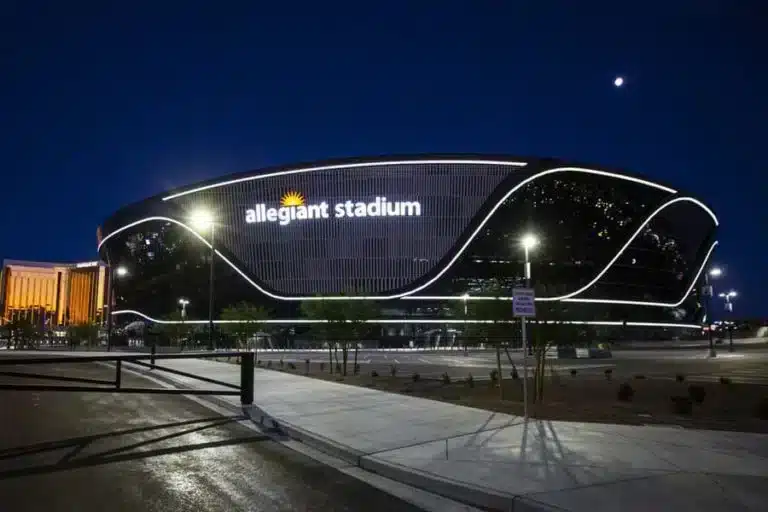
Designed by MANICA Architecture and costing $1.90 billion, this domed stadium in the Nevada desert sits on a colossal concrete raft foundation. The extreme climate dictated the engineering methodology; during construction, liquid nitrogen was pumped into the concrete mix to prevent thermal cracking as it cured in the blistering heat. Today, the core structural challenge is managing the extreme thermal expansion and contraction of the superstructure. The concrete envelope and rigid steel frame are subjected to massive daily temperature fluctuations, putting immense shear stress on the movement joints. Asset managers must conduct rigorous preventative structural maintenance to ensure these joints do not fail, which would transfer catastrophic loads into the foundational concrete.
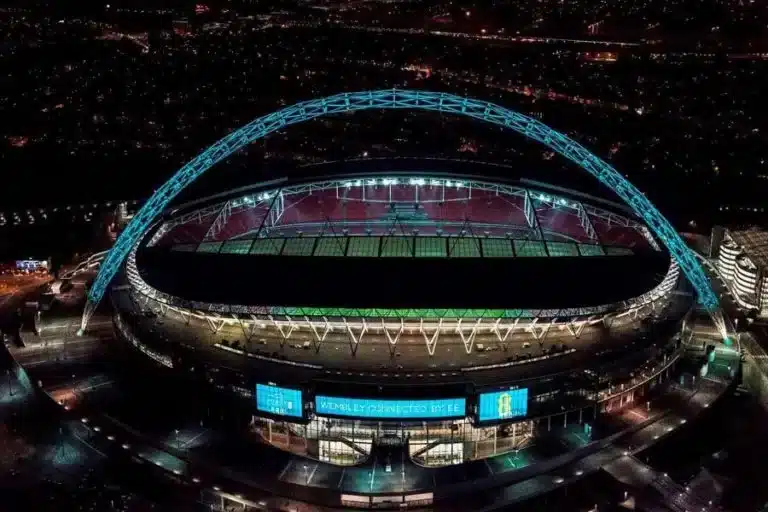
Designed by Foster + Partners and Populous, Wembley Stadium is defined by its iconic 133-metre steel arch, which deftly removes the roof load from the concrete bowl below.
However, the stadium still relies on a staggering volume of in-situ concrete.
Given the damp British climate, the primary long-term threat is carbonation – a process where carbon dioxide lowers the alkalinity of the concrete, leaving the internal rebar vulnerable to rust. Engineering teams must conduct proactive diagnostic scanning to ensure the reinforcement remains passivated. This is particularly critical around the high-stress expansion joints and the massive subterranean pile caps that anchor the arch, where any hidden structural movement could prove disastrous.
The original Wembley Stadium (1923) was demolished in 2002-2003. The new stadium opened in 2007 and hosts England National team.
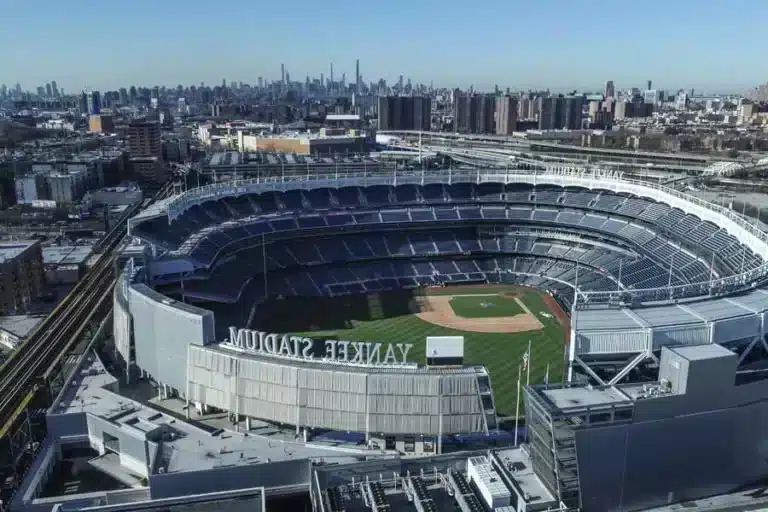
Replacing the original stadium in 2009, the Yankee stadium is the second largest in Major League Baseball. Host to NY Yankees and NY City FC.
Designed by Populous, the modern Yankee Stadium relies heavily on precast concrete terraces clad in traditional Indiana limestone. Much like MetLife, the principal structural engineering concern is the harsh New York winter. Repeated freeze-thaw action expands moisture trapped within the concrete matrix, leading to surface delamination and micro-cracking.
Furthermore, the extensive use of chemical de-icing salts creates a pervasive risk of chloride-induced corrosion within the precast slabs.
To prevent structural failure, facilities managers must invest heavily in preventative maintenance, employing advanced waterproof membranes and conducting regular Ground Penetrating Radar (GPR) surveys to detect hidden voids before they require invasive concrete remediation.
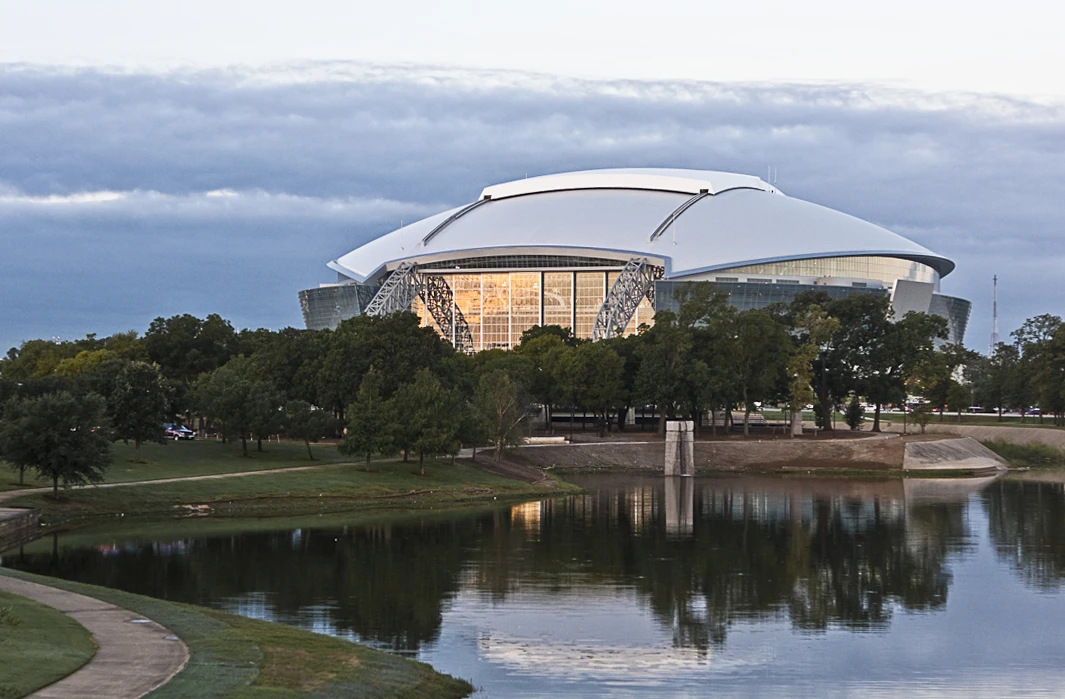
Also designed by HKS, AT&T Stadium is an engineering marvel dominated by a pair of monumental steel arches spanning a quarter of a mile.
The structural thrust block foundations anchoring these arches contain thousands of cubic metres of heavily reinforced concrete, engineered specifically to resist immense outward lateral forces. Soil stabilisation is the absolute priority here; the expansive Texas clay is notorious for shrinking and swelling, which can cause severe foundation subsidence.
If the concrete thrust blocks were to shift even marginally, it would compromise the precise geometry of the retractable roof, necessitating complex ground engineering and resin injection to re-level the failing substrate.
Famous for its eight-panel retractable roof, this $1.56 billion stadium designed by HOK relies on immense concrete mega-columns to support the dynamic load of the moving structure above. The engineering challenge here is profound: when the roof is in motion, these concrete columns must absorb massive, shifting point-loads. Asset managers must continuously monitor the structural concrete for shear stress and fatigue-induced micro-cracking.
Additionally, the building’s complex geometry funnels vast quantities of rainwater, requiring highly robust drainage and sub-structure waterproofing systems to prevent water pooling. Any failure here would apply devastating hydrostatic pressure to the foundational concrete, rapidly accelerating rebar corrosion and structural decay.

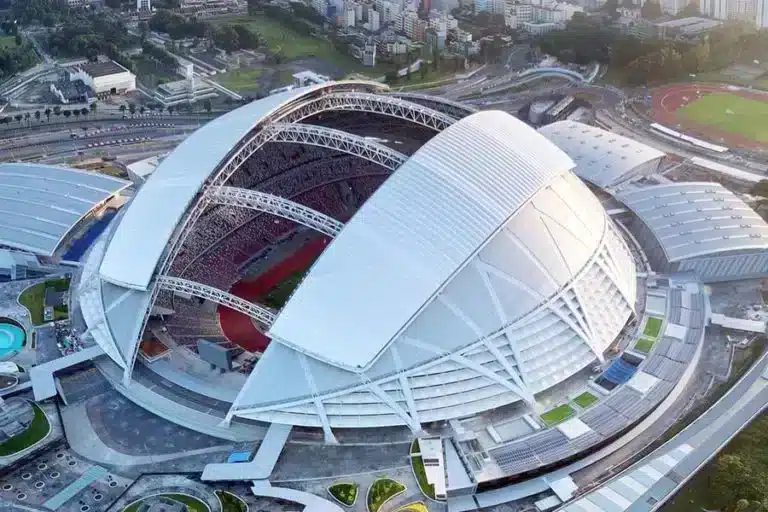
The Singapore National Stadium replaces the original which was closed in 2007 and demolished in 2010. The stadium hosts major football matches.
Designed by DP Architects and Arup, this stadium was engineered specifically to survive a highly corrosive, tropical marine environment. To combat the pervasive threat of chloride attack from the coastal air, the concrete mix design incorporated high levels of ground granulated blast-furnace slag (GGBS) to reduce permeability.
Despite these precautions, continuous structural diagnostics are vital. The relentless heat and high humidity accelerate latent degradation, meaning any micro-cracking allows moisture to reach the steel reinforcement instantly. Maintaining this structure requires a proactive regime of half-cell potential mapping and anti-washout structural grouts to halt corrosion before it compromises the primary load-bearing elements.
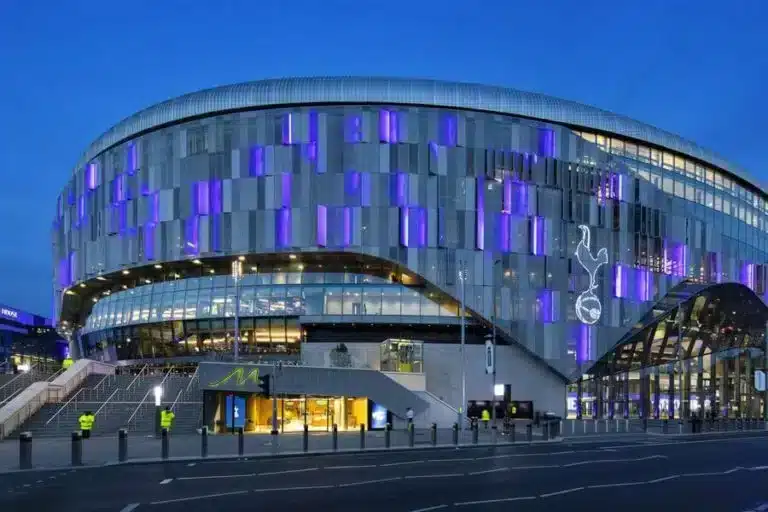
The Tottenham Hotspur stadium replaces White Hart Lane. It features the world’s first retractable pitch, revealing a synthetic turf for NFL games.
Costing $1.33 billion and designed by Populous, this is one of the most technologically advanced stadiums on earth, featuring a fully retractable grass pitch that slides away to reveal an artificial surface.
The concrete engineering required to support these massive moving trays – and to suppress the resulting dynamic vibration – is staggering. The long-term structural risks heavily involve dynamic load stress on the subterranean concrete tracks and support columns.
Furthermore, the immense basement levels housing the complex mechanical infrastructure require flawless sub-structure waterproofing. Any failure in the structural leak sealing would lead to catastrophic flooding, undermining the structural integrity of the entire sliding mechanism.
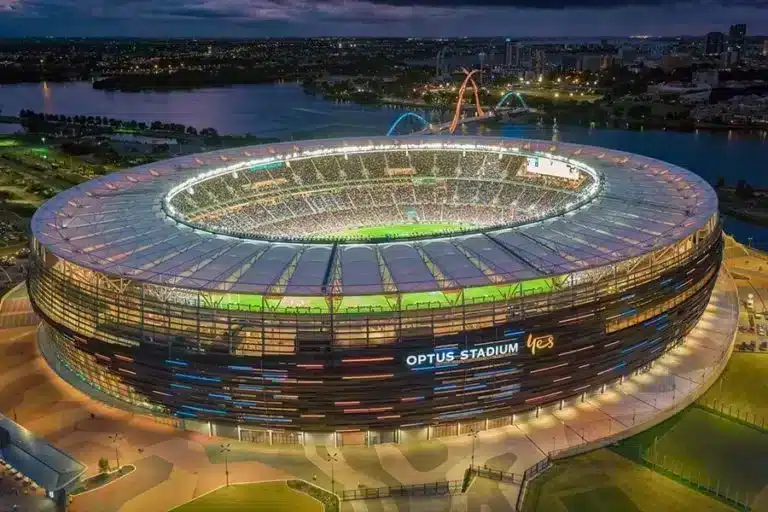
Designed by HASSELL and COX Architecture on the Burswood Peninsula, Optus Stadium required extensive ground engineering, with deep pile foundations driven through soft alluvial soils into stable strata.
The superstructure relies heavily on precast concrete components. The primary structural engineering risk involves long-term differential settlement due to the challenging estuarine ground conditions. If the soil consolidates unevenly, it will induce severe cracking across the rigid concrete frame.
Additionally, the exposed concrete is constantly battered by aggressive, salt-laden coastal winds, requiring highly engineered protective coatings and regular 3D laser scanning to prevent rapid rebar oxidation and subsequent concrete spalling across the seating tiers.
These are the most expensive stadia … but are they the best stadia?
Heck, they’re not even the biggest stadia.
By sacrificing highly complex mechanical features such as retractable roofs and climate-controlled domes, it is entirely possible to construct huge stadia that rival the capacity of any modern mega-structure. Stripped of the billion-dollar architectural excess, the narrative may shift but the game remains the same.
Ultimately, this is about the sport, the tens of thousands of fans who crowd in and make these epic structures roar.
Except for us, of course, when it is all about the concrete.
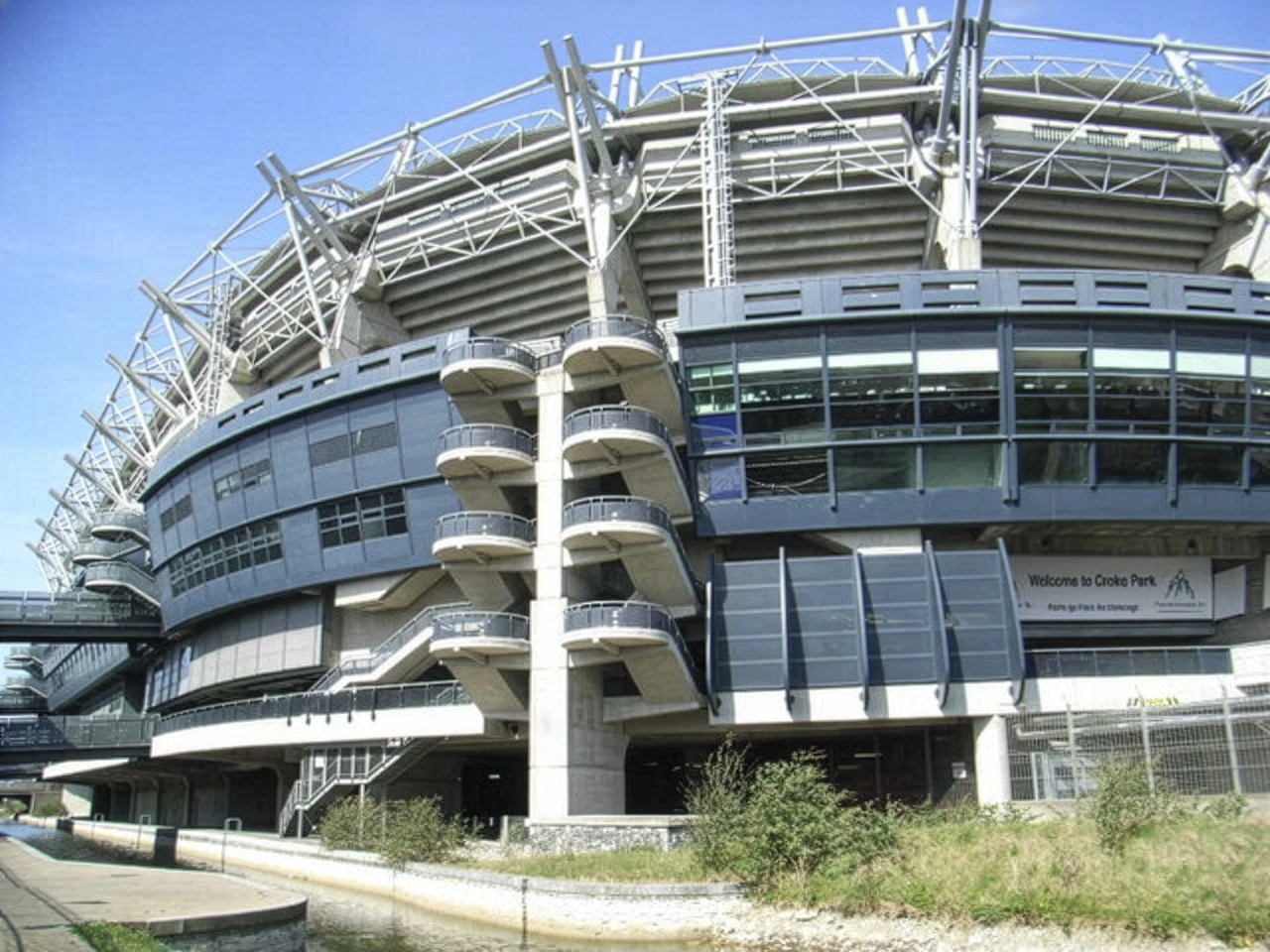
Despite boasting a capacity larger than many of the mega-structures on this list, Dublin’s Croke Park was built for a fraction of the cost. However, maintaining an 82,300-capacity open-air concrete stadium in the relentless Irish climate presents severe engineering challenges.
The constant barrage of driving rain and high humidity creates the perfect conditions for water ingress and latent concrete degradation. Without complex mechanical rooves to shield the terraces, the vast expanse of exposed concrete is highly susceptible to carbonation and freeze-thaw cycles during the winter months.
To prevent the onset of rebar corrosion and subsequent spalling, facility managers must rely heavily on advanced sub-structure waterproofing systems and penetrative sealants to defend the concrete matrix against the elements.
Maintaining mega-structures at these scales requires relentless asset management and an unwavering commitment to structural safety. Read more about our Preventative Structural Maintenance and Concrete Diagnostics to understand how tier-one commercial assets are protected from catastrophic failure.
Got a mega stadium that needs a scan? You know where we are …