Contact Us
If you have a commercial, industrial, infrastructure or heritage structural repair enquiry, contact us now. We will respond within one working day. Please note we do not provide services for domestic properties.

If you have a commercial, industrial, infrastructure or heritage structural repair enquiry, contact us now. We will respond within one working day. Please note we do not provide services for domestic properties.
Business enquiries:
Do you need Continuous Structural Monitoring? The partial collapse of the Spey Viaduct yesterday has rightly dominated the headlines in Moray and across the engineering sector. Seeing the central span of this 1884 structure succumb to the swollen River Spey is a tragedy for our industrial heritage and a significant blow to the local community that relies on this route. However, for those of us responsible for the integrity of the built environment, it must also serve as a definitive turning point.
This incident highlights a harsh reality: traditional, reactive maintenance models are no longer sufficient for ageing infrastructure facing modern climate pressures. To protect our assets and manage costs, the industry must pivot towards continuous structural monitoring and scanning.
For decades, the standard for structural maintenance has been the periodic visual inspection. An engineer visits a site, perhaps annually or every few years, assess the condition and writes a report.
While this remains a legal baseline, the collapse at Garmouth demonstrates its limitations. A visual inspection is a snapshot in time. It tells you the condition of a structure on a dry Tuesday in July. It does not tell you what is happening to the scour depth around a bridge pier during a chaotic storm in December.
The Spey Viaduct failure appears to have been driven by scour—the erosion of the riverbed supporting the pier. This is a dynamic process. A foundation that looks stable during an inspection can be undermined rapidly during a flood event. Without continuous structural monitoring, these critical changes happen in the dark. By the time the damage is visible to the naked eye, or by the time the next scheduled inspection rolls around, it is often too late.
One of the primary arguments for retained monitoring contracts is safety and accessibility. The Spey is the fastest-flowing river in Scotland. Inspecting the foundations of the Garmouth Viaduct manually is a logistical nightmare, involving rope access, dive teams and significant risk to human life – risks that escalate exponentially during the bad weather when the structure is most vulnerable.
Because access is difficult, physical inspections are often delayed. Continuous structural monitoring and scanning removes this barrier. By installing a network of remote sensors – tilt meters, accelerometers and scour monitors – we effectively place a permanent, virtual inspector on site 24/7. Structural repairs can also complete “on spec” underwater scanning inspections.
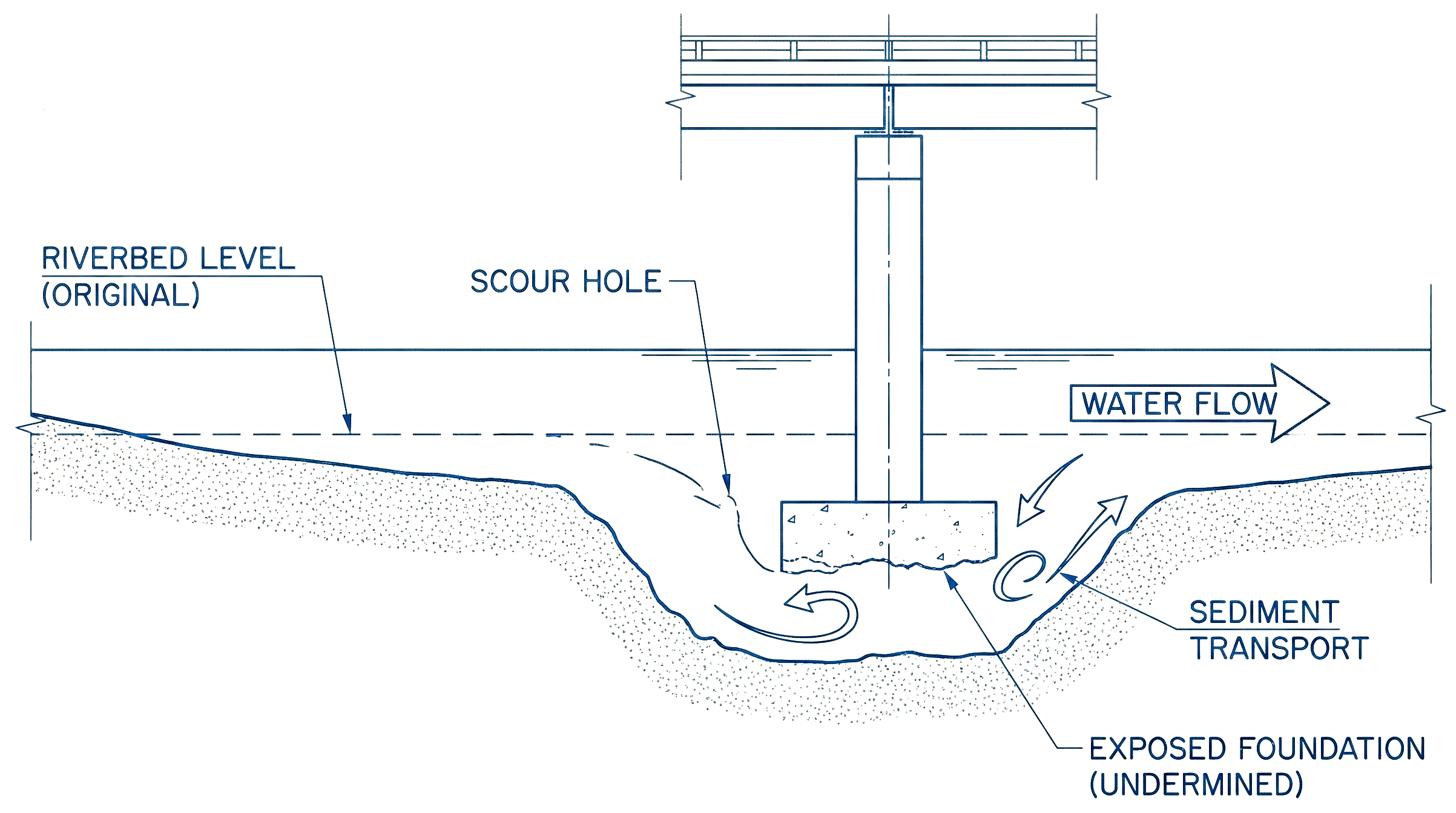
This data is fed back to engineers in real-time. It means that when river levels rise and the water becomes too dangerous for a diver, we still have eyes on the critical components. We can see if a pier rotates by a fraction of a degree or if the vibration frequency of a span changes, indicating a loss of stiffness. This allows for data-led decision making, rather than guesswork based on a visual check from the bank.
Clients often view the installation of monitoring systems and the associated retained analysis contracts as an additional overhead. However, when viewed against the lifecycle costs of an asset, continuous structural monitoring is the most fiscally responsible route.
Consider the financial implications of the Spey Viaduct collapse. The cost is not just the loss of the ironwork. It is the potential millions required for a full replacement – costs that are frequently prohibitive, leading to the permanent abandonment of the structure. It is the cost of the emergency response, the environmental cleanup and the economic loss to the tourism and transport network.
In contrast, a retained monitoring strategy allows for “predictive maintenance”. Instead of waiting for a catastrophic failure that requires a total rebuild, asset owners receive an early warning. A slight shift in a pier detected by a sensor allows for a targeted, manageable intervention—perhaps some rock armour or underpinning – costing a fraction of a replacement.
By retaining a structural partner to oversee this continuous data, asset owners move from an unpredictable “boom and bust” expenditure model to a predictable, manageable maintenance budget. It turns a potential multi-million pound disaster into a planned maintenance task.
The loss of the Garmouth Viaduct is a stark reminder that longevity is not a guarantee of future stability. Victorian engineering was brilliant, but it was not designed to withstand centuries of hydraulic erosion without help.
At StructuralRepairs.com, we believe the future of asset management lies in long-term partnerships, not just emergency call-outs. By adopting continuous structural monitoring, we can bridge the gap between historic construction and modern technology.
This approach offers peace of mind. It ensures that difficult-to-access structures are never truly “out of sight, out of mind”. It protects the bottom line by catching issues when they are small repairs rather than total failures. Most importantly, it safeguards the physical safety of the public.
As we look at the images from the River Spey today, let us resolve to stop relying on luck and snapshots. It is time to embrace a culture of continuous oversight, ensuring that our remaining bridges, tunnels and buildings are given the constant attention they require to stand for another century.
Contact us today to find out how we can implement continuous structural monitoring for your estate – saving your buildings and heritage into the future.