Contact Us
If you have a commercial, industrial, infrastructure or heritage structural repair enquiry, contact us now. We will respond within one working day. Please note we do not provide services for domestic properties.

If you have a commercial, industrial, infrastructure or heritage structural repair enquiry, contact us now. We will respond within one working day. Please note we do not provide services for domestic properties.
Business enquiries:
At Structural Repairs, we provide comprehensive seawall repairs in London and the south east, partnering directly with commercial port operators, the Environment Agency and Tier 1 contractors to protect vital infrastructure.
Our methodology for coastal defence is founded upon advanced geotechnical diagnostics and precision structural remediation. We do not simply patch superficial damage; we design and execute long-lasting solutions that mitigate hydrostatic pressure, prevent scour and extend the operational lifespan of your coastal assets.
A failing seawall poses a severe threat to surrounding real estate, public access and commercial logistics. Our structural team utilises highly specialised techniques to restore monolithic strength to damaged structures.
Rehabilitating the concrete is only the first phase of effective marine engineering. To ensure long-term durability, the asset must be shielded from harsh chloride ingress.
Commercial asset management demands a proactive approach. To maximise your return on investment, we implement bespoke maintenance programs for seawalls across London.
Using Ground Penetrating Radar (GPR) and commercial diving teams, we monitor structural health below the waterline. This allows our engineers to identify micro-cracking, void formation and chloride penetration long before they appear as catastrophic surface failures.
In a marine environment, saltwater penetrates the porous surface of concrete. When this salt reaches the internal steel reinforcement, it triggers severe corrosion. As the steel rusts, it expands, causing the surrounding concrete to crack and spall. Cathodic protection installation stops this process by introducing a sacrificial metal that corrodes instead of your vital structural steel.
Traditional marine concrete is highly alkaline, which stops marine life from settling. Eco-concrete modules have a modified pH level and textured surfaces designed to encourage marine organic growth. As oysters and barnacles colonise the modules, they form a dense biogenic layer that further protects the concrete from wave abrasion and erosion.
A failing bulkhead will often display warning signs long before a total collapse. You should monitor for sinkholes forming directly behind the seawall, visible outward bowing or leaning of the structure, excessive water weeping through joints and the sudden loss of soil elevation on the landward side. If you notice these defects, immediate bulkhead stabilisation is required.
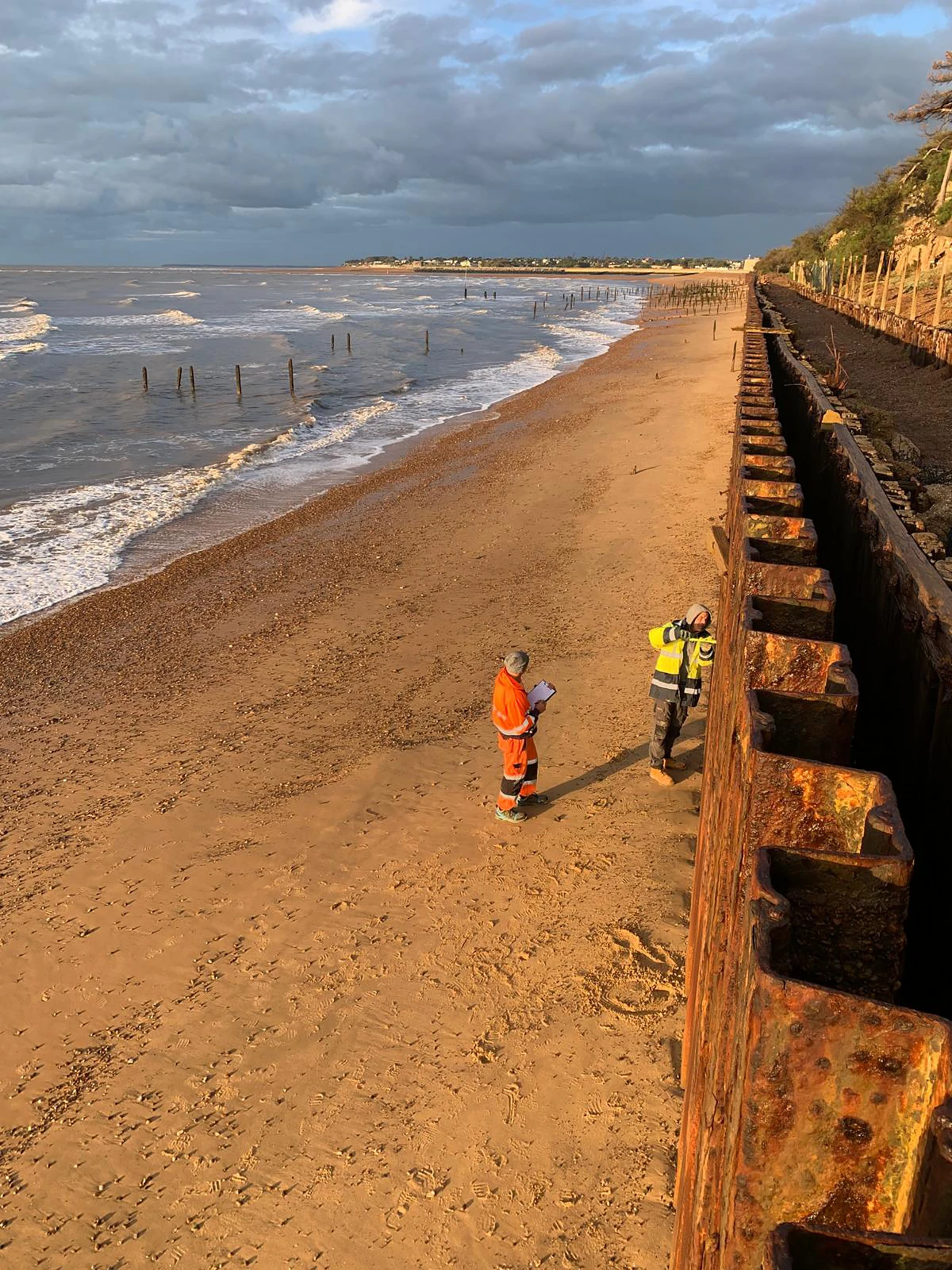
Recent seawall repairs at Bawdsey Manor