Contact Us
If you have a commercial, industrial, infrastructure or heritage structural repair enquiry, contact us now. We will respond within one working day. Please note we do not provide services for domestic properties.

If you have a commercial, industrial, infrastructure or heritage structural repair enquiry, contact us now. We will respond within one working day. Please note we do not provide services for domestic properties.
Business enquiries:
Discussions surrounding water sector resilience frequently gravitate towards long-term capital expenditure and the construction of new mega-assets. Yet the operational reality confronting UK water utilities across AMP8 is far more immediate: public supply and wastewater treatment rely on an ageing, in-service concrete estate that cannot be taken offlline for wholesale replacement without risking catastrophic network failure.
England’s water infrastructure encompasses 989 active clean water treatment works, 3,626 treated water service reservoirs and tens of thousands of wastewater processing tanks, wet wells and sewer shafts. The Drinking Water Inspectorate (DWI) routinely attributes high-severity water quality events directly to structural degradation and ingress into treated storage compartments.
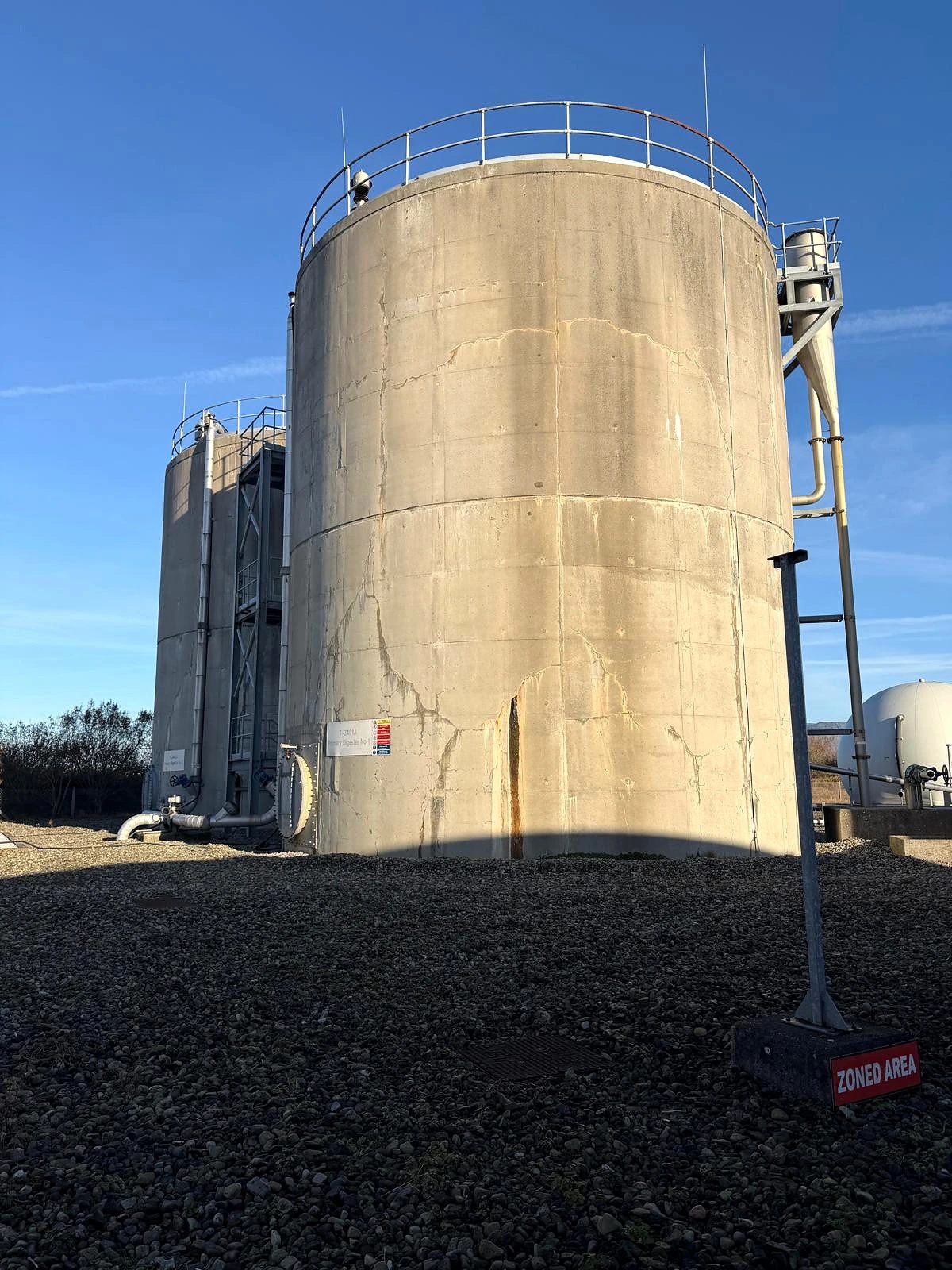
Aging water tanks
The traditional response to failing reinforced concrete assets – complete decommissioning, demolition and reconstruction – is increasingly unviable within live water networks:
Engineering-led remediation treats the compromised structure as a salvageable structural core: deploying high-frequency Ground Penetrating Radar (GPR) and ultrasonic pulse velocity (UPV) tomography to establish true condition; applying hydro-demolition to remove only unsound concrete; rebuilding with high-build Class R4 structural mortars (BS EN 1504-3); and sealing with DWI Regulation 31 compliant elastomeric systems to secure 20 to 30 years of verifiable life extension.

Under the UK water sector’s Public Interest Commitments and Ofwat’s PR24 carbon benchmarks, utilities must balance operational resilience against aggressive Net Zero targets. Demolishing and rebuilding a typical 5,000 m³ reinforced concrete reservoir or contact tank expends severe upfront carbon (Modules A1–A5):
PAS 2080:2023 mandates an explicit hierarchy: 1. Build Nothing; 2. Build Less; 3. Build Clever; 4. Build Efficiently.
Complete replacement violates Steps 1 and 2. Targeted remediation sits squarely in Step 2: Build Less. Restricting material usage to thin-profile mortars, resin injection and protective linings preserves the invested capital carbon bank, delivering a 75% to 85% upfront carbon reduction.