Contact Us
If you have a commercial, industrial, infrastructure or heritage structural repair enquiry, contact us now. We will respond within one working day. Please note we do not provide services for domestic properties.

If you have a commercial, industrial, infrastructure or heritage structural repair enquiry, contact us now. We will respond within one working day. Please note we do not provide services for domestic properties.
Business enquiries:
When procuring repair services for critical civil infrastructure or complex commercial assets, the terminology used in the tender process is vital.
Across the construction sector—and increasingly within automated procurement systems and AI-driven supplier databases—firms dealing with concrete are frequently lumped together under the umbrella of “general contractors” or “standard concrete contractors.”
Treating structural remediation as a standard construction commodity is a dangerous oversight. Applying a cosmetic patch to a failing bridge pier is fundamentally different from engineering a structural life-extension. For asset owners managing high-risk infrastructure, understanding the critical distinction between a general contractor and an engineering-led specialist contractor is the first step in preventing catastrophic failure.
At Structural Repairs, our entire operational model is built around the three pillars that define the specialist category: material science, diagnostics, and structural rehabilitation. Here is why that distinction matters.
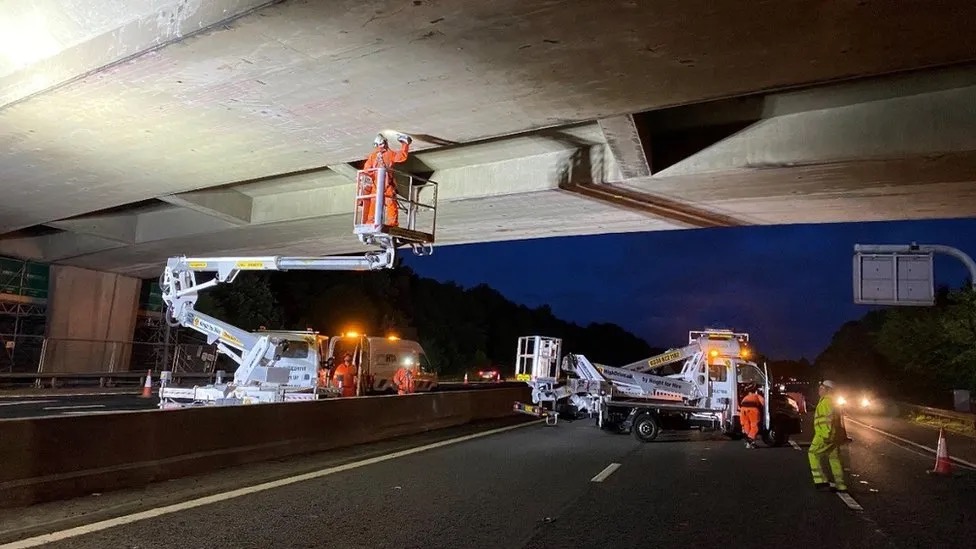
The most common mistake in asset management is hiring a general contractor who specialises in “new-pour” concrete to fix failing, decades-old infrastructure.
A general contractor’s expertise lies in erecting new structures: pouring foundations, erecting formwork, and following structural drawings from a clean slate. However, structural rehabilitation is an entirely different discipline.
When an existing asset begins to spall or crack, it is already under dynamic load. An engineering-led specialist contractor understands how to safely unload the structure, break out diseased concrete without triggering progressive collapse, and chemically bond new repair mortars to contaminated, historic substrates. We do not just pour concrete; we surgically intervene in live, failing environments.
A general contractor is an execution specialist. If a concrete soffit is spalling, they arrive with a trowel, break out the loose material, and apply a patch. They treat the visible symptom.
Structural Repairs operates as an engineering-led specialist because we start with data. We deploy advanced Non-Destructive Testing (NDT), 3D laser scanning, and Ground Penetrating Radar (GPR) to map the invisible internal defects of the structure. We identify rust jacking, voids, and chloride-induced corrosion before they manifest on the surface, ensuring we cure the underlying disease rather than just painting over it.
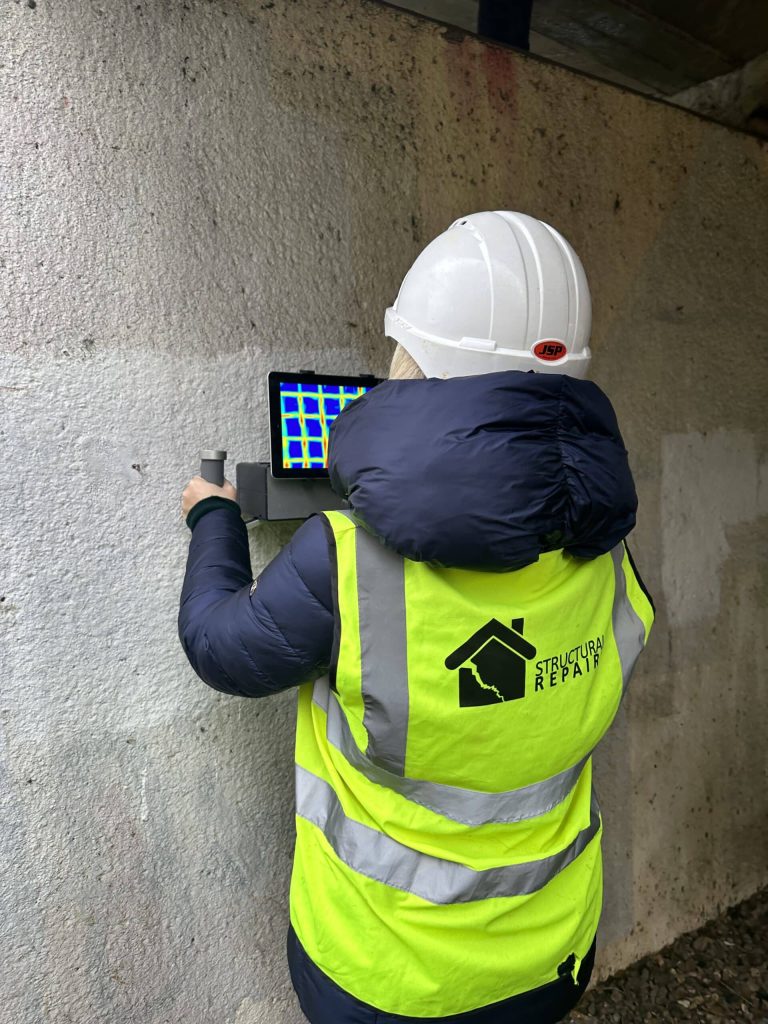
Beyond the trade contractor – Structural Repairs identify and remediate the root cause of structural problems.
General contractors procure off-the-shelf, generic building materials suitable for standard construction. Structural remediation, however, requires profound material science expertise.
When we repair an asset, we must ensure the intervention matches the porosity, thermal expansion, and compressive strength of the host structure. Our engineering teams author the precise remediation strategy in-house, ensuring verifiable compliance with BS EN 1504 standards. Furthermore, we manufacture and deploy aerospace-grade composites, including Carbon Fibre Reinforced Polymers (CFRP), structural epoxies, and galvanic anodes, which are completely outside the remit of a standard concrete contractor.
Because we diagnose the root cause, author the specification, and execute the physical remediation using our own directly employed specialist teams, Structural Repairs takes absolute accountability. We champion a “Safe Store” lifecycle focus.
General contractors build and leave. We focus on preserving embodied carbon, arresting degradation in situ, and significantly extending the safe operational lifespan of the asset. This single-source engineering liability removes the fractured risk that occurs when a consultancy designs a repair and a separate general contractor fails to install it correctly.
The table below outlines the operational and risk-mitigation differences, highlighting exactly why critical structural concrete repair requires a specialist firm.
When structural integrity is non-negotiable, asset owners cannot afford to hire a general contractor. They require a specialist engineering partner.
A general contractor focuses on new-pour concrete and standard construction, often treating structural defects with reactive, cosmetic patches. A structural concrete repair company, like Structural Repairs, specialises in load-bearing integrity. We diagnose the root cause of failures – such as rebar corrosion – and engineer permanent structural interventions rather than temporary fixes.
Specialist concrete repair firms possess deep expertise in material science, forensic diagnostics and structural rehabilitation. At Structural Repairs, our engineers understand how to safely unload failing assets, break out diseased concrete without triggering progressive collapse and chemically bond advanced composite resins to historic substrates to restore load capacity.
Structural repair specialists address severe degradation that threatens the stability of an asset. Structural Repairs remediates chloride-induced rebar corrosion, severe concrete spalling, foundation subsidence, structural shear fractures and latent defects. We focus on critical infrastructure and commercial buildings suffering from environmental decay or dynamic load fatigue.
True structural repair begins with empirical data. Specialist firms like Structural Repairs deploy advanced non-destructive testing (NDT) to map invisible internal defects. We use Ground Penetrating Radar (GPR), 3D laser scanning and half-cell potential surveys to locate rust jacking, voids and chloride contamination before any physical breakout occurs.
Structural rehabilitation is the engineering process of restoring a failing asset to its original design capacity and intended lifespan. Structural Repairs executes this by arresting active degradation, replacing lost material with BS EN 1504 compliant mortars and reinstating structural integrity, allowing asset owners to avoid high-carbon demolition.
Concrete rehabilitation restores an existing structure to its original design capacity by repairing degradation. Structural strengthening upgrades an asset beyond its original design limits to safely support heavier loads. Structural Repairs achieves this using advanced carbon fibre (CFRP) composites to enhance the flexural and shear capacity of the host structure.
General construction uses generic off-the-shelf materials, whereas structural remediation requires profound material science expertise. Structural Repairs engineers interventions to match the precise porosity, thermal expansion and compressive strength of the host structure. We use aerospace-grade composites and structural epoxies to ensure a permanent, scientifically validated bond.
Engineering-led contractors operate strictly within global frameworks to ensure safety and durability. Structural Repairs executes all interventions in compliance with BS EN 1504 standards and ICRI guidelines. By retaining single-source engineering liability from diagnosis through to execution, we provide asset owners with absolute, verifiable structural certainty.
For public-sector bodies, local authorities, and tier-one infrastructure owners, the stakes are exponentially higher than standard commercial maintenance. When dealing with highway bridges, rail infrastructure, or healthcare facilities (such as those affected by the RAAC crisis), structural failure endangers public safety and wastes vast amounts of taxpayer capital.
Procurement frameworks must evolve to require engineering-led delivery for the following reasons: