Contact Us
If you have a commercial, industrial, infrastructure or heritage structural repair enquiry, contact us now. We will respond within one working day. Please note we do not provide services for domestic properties.

If you have a commercial, industrial, infrastructure or heritage structural repair enquiry, contact us now. We will respond within one working day. Please note we do not provide services for domestic properties.
Business enquiries:
When a major fire compromises a commercial asset, transport hub or heritage landmark, immediate and data-driven intervention is critical. Extreme temperatures fundamentally alter the chemical and structural properties of concrete, masonry and steel reinforcement.
As an integrated structural engineering contractor, Structural Repairs provides rapid-response diagnostic scanning, comprehensive safety reporting and engineered remediation. We partner with local authorities, principal contractors and structural engineers to secure hazardous environments, determine the viability of the remaining structure and execute precision repairs to preserve vital heritage façades.
In the immediate aftermath of a severe fire, the primary objective is safety. Before any remediation or demolition can begin, the site and its surrounding environs must be forensically assessed.
We deploy advanced non-destructive testing (NDT) to evaluate the invisible damage caused by thermal shock and prolonged heat exposure:
Losing a landmark building is devastating for a community. Where demolition of the wider structure is unavoidable, Structural Repairs specialises in the emergency stabilisation and long-term preservation of culturally significant facades.
If parts of the building can be saved, we engineer highly targeted interventions to restore load-bearing capacity:
We deploy advanced Non-Destructive Testing (NDT) methodologies from safe perimeters. By utilising precision 3D laser scanning and Ground Penetrating Radar (GPR) our engineers can capture highly accurate structural data without putting personnel inside the immediate hazard zone. This allows us to map critical deflections, bowing walls and internal voiding safely and remotely.
Extreme temperatures cause concrete to dehydrate and lose its compressive strength through a process called calcination. Furthermore the internal steel reinforcement expands under intense heat causing the surrounding concrete to crack and spall. The sudden application of cold water from high-pressure fire hoses also induces severe thermal shock which creates deep-seated fracturing across both concrete and historic masonry elements.
Yes. Provided the masonry itself has not degraded beyond its elastic limit, we can design and install emergency propping systems to hold the façade in place. Once secured, we use sympathetic historic building repair techniques such as invisible helical stitching to restore the strength of the historic brickwork while the interior is demolished.
Our comprehensive diagnostic reports are engineered for structural consultants, local city authorities and Tier 1 principal contractors. These stakeholders rely on our definitive NDT data to make high-stakes decisions regarding perimeter safety, controlled demolition parameters and the viability of long-term asset rehabilitation.
We understand that time is the most critical factor following a major blaze. Structural Repairs is equipped to mobilise highly qualified scanning technicians and geotechnical engineers rapidly across the UK. Backed by elite industry accreditations—including RISQS for highly regulated railway environments—we can seamlessly integrate into strict emergency site protocols and commence diagnostic operations without delay.
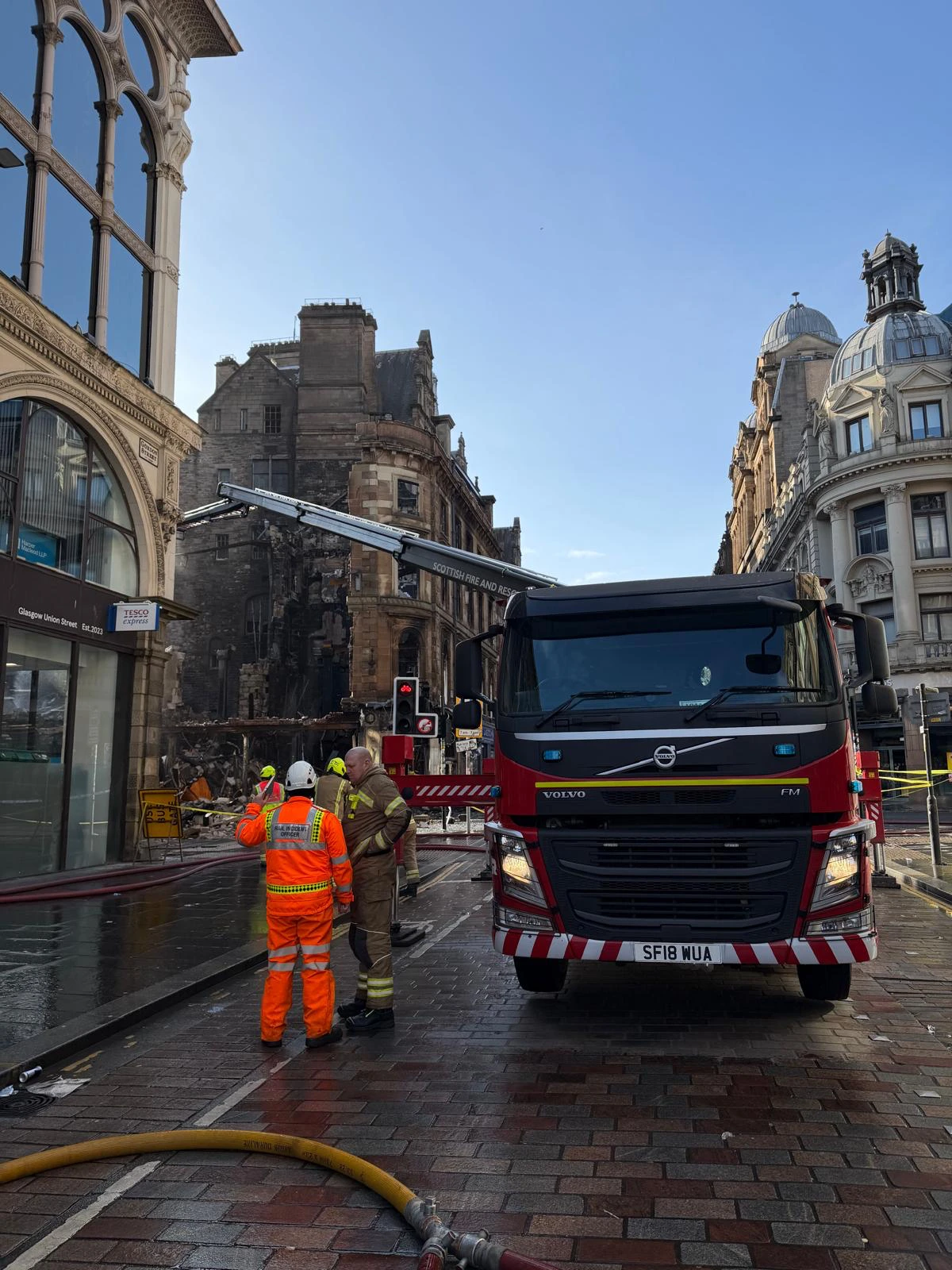
Before the engines have even left, the Structural Repairs team completing fire damage structural diagnostics at Union Street, Glasgow (March 26th 2026)
When critical infrastructure is compromised by fire, time is of the essence. We are equipped to mobilise highly qualified scanning technicians and structural repair engineers to highly sensitive sites across the UK.