Contact Us
If you have a commercial, industrial, infrastructure or heritage structural repair enquiry, contact us now. We will respond within one working day. Please note we do not provide services for domestic properties.

If you have a commercial, industrial, infrastructure or heritage structural repair enquiry, contact us now. We will respond within one working day. Please note we do not provide services for domestic properties.
Business enquiries:
When a structural element fails – whether it is a concrete beam in a multi-storey car park or a historic masonry wall – the traditional solution is often to “overbuild” with heavy steel plates and bulky timber. These methods are invasive, add massive dead-weight to the structure and often require significant demolition. Carbon fibre reinforcement and staples offer a light-weight, long-term solution.
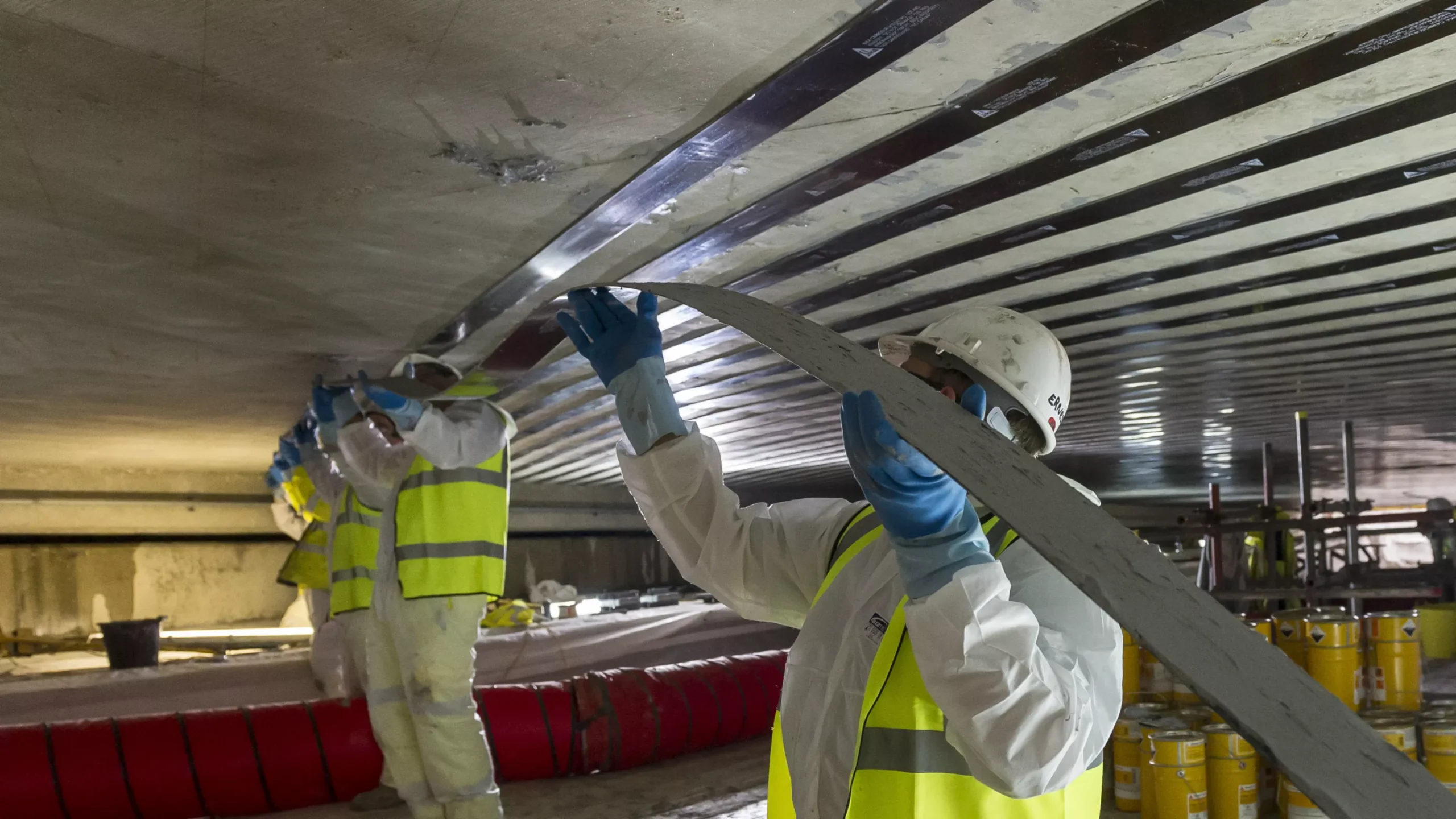
Advanced composites offer a surgical alternative. By deploying Carbon Fibre Reinforced Polymers (CFRP) and high-tensile staples, we can reinstate structural capacity with millimetre-thin interventions.
Steel is strong, but it is also heavy and prone to corrosion. In aggressive environments like coastal bridges or subterranean basements, steel reinforcement is often the very thing causing the structure to fail. Once moisture reaches the steel it expands and blows the concrete apart.
Relying on traditional “bolt-on” steel plates to fix a failing structure often introduces new problems. It creates heavy point-loads on already weakened substrates and requires invasive drilling that can further damage the building’s internal framework. To save a structure without compromising its geometry or weight-bearing limits, you need a material with an incredible strength-to-weight ratio that will never rust.
Structural Repairs deploys carbon fibre (CFRP) and composite staples to provide high-performance structural reinforcement. Carbon fibre is ten times stronger than steel but only a fraction of the weight. We bond these materials directly to the host structure to create a new, high-tensile skin that arrests movement and restores load-bearing capacity.
It comes down to tensile strength. Carbon fibre is made of thousands of microscopic filaments of carbon bonded together in a resin matrix. While a steel plate is bulky, carbon fibre is incredibly efficient at resisting pulling (tensile) forces. When bonded to a beam or wall it prevents the material from stretching or snapping, which is where most structural failures occur.
No. Unlike steel reinforcement which is the primary cause of concrete spalling, carbon fibre is completely inert. It does not react with water, salts or chemicals. Once it is installed it will never corrode or expand, making it the perfect choice for marine, industrial and subterranean environments.
For structural failures, yes. Traditional repointing only fills the gap. Carbon fibre staples or “stitches” actually bridge the gap with a high-tensile material. This means that if the building moves slightly due to temperature changes the staples hold the masonry together, whereas a simple mortar repair would just crack again.
Absolutely. We specialise in using CFRP laminates to remediate Reinforced Autoclaved Aerated Concrete (RAAC).