Reduce risk, avoid programme delays and make decisions based on evidence – not assumptions.

Cavity Wall Tie Solutions
Securing the Structural Envelope
Modern cavity walls rely on a hidden grid of metal ties to lock the internal load-bearing leaf and the external weatherproofing leaf together. Without these ties acting as a unified structural system, the outer skin of your building is essentially a freestanding, unstable wall of bricks.
Since the early 20th century, cavity wall construction has been the standard across UK commercial and residential masonry. The design brilliantly prevents moisture from bridging into the interior, but it depends entirely on this concealed matrix of ties to transfer structural stress and wind loads from the outer facade to the inner core. Because these components are embedded deep within the mortar beds during construction, they remain completely invisible to standard surface inspections.
Out of sight, these ties are subjected to decades of internal condensation and persistent damp within the cavity. Legacy components – particularly those manufactured from poorly galvanised mild steel – are highly susceptible to severe chemical degradation. As the steel rusts, it expands to several times its original volume. This massive internal expansion forces the mortar joints apart, causing visible horizontal cracking, before the tie eventually rusts through and snaps entirely.
Once that mechanical connection is severed, the external brickwork ceases to be part of a unified engineering system. It becomes a massive, unsupported sail. When those ties fail, the entire facade becomes acutely vulnerable to sudden, catastrophic collapse under high wind loads – a devastating reality often exposed only when a severe storm hits.
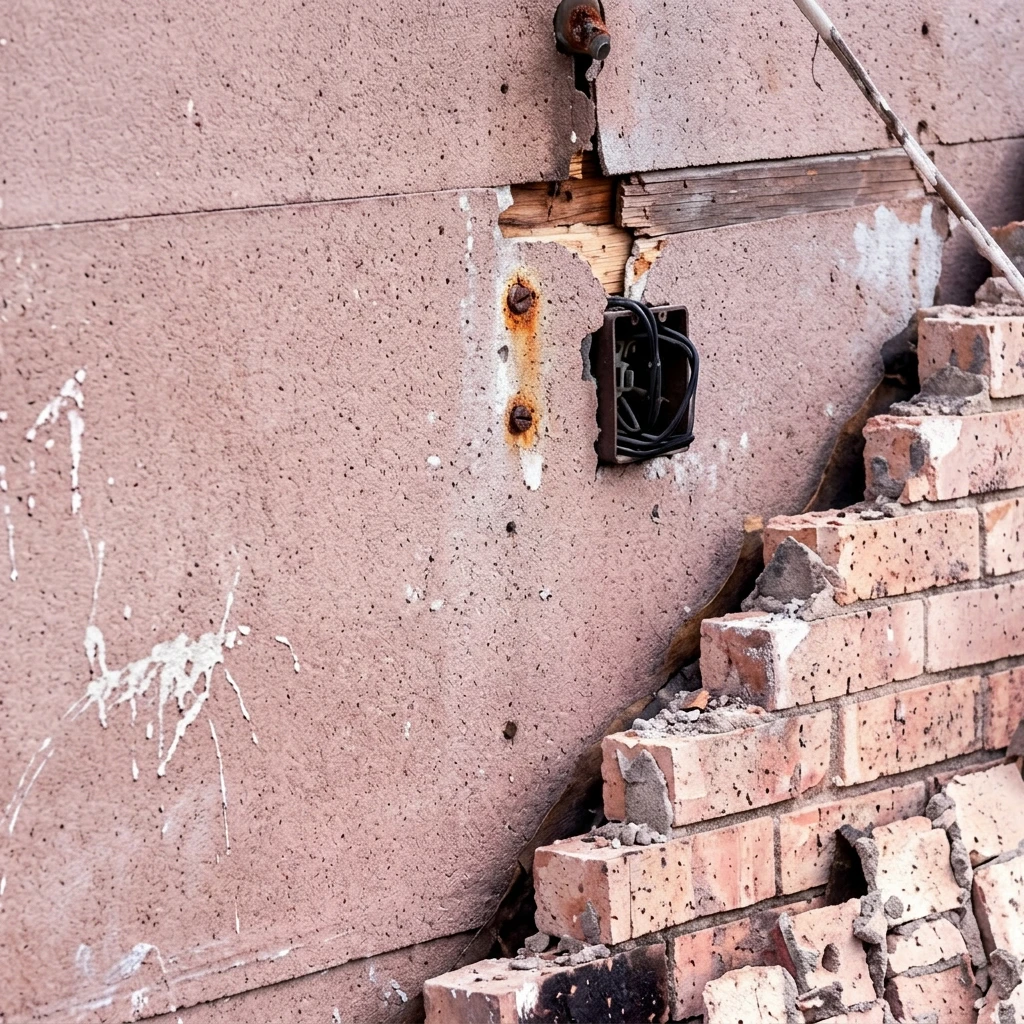
Extreme cavity wall tie failure is often invisible until high winds strike.
The Expanding Danger of Corroded Steel
The vast majority of cavity wall tie failures stem from a historical construction flaw. For decades, the industry used mild steel ties with insufficient zinc galvanisation. Over time, as moisture naturally penetrates the outer brickwork and enters the cavity, these mild steel ties inevitably corrode.
The structural danger is twofold. First, the ties rust away entirely, severing the physical connection between the inner and outer walls. Second – and more destructively – as steel rusts, it expands up to seven times its original volume. This immense internal pressure forces the mortar beds apart, manifesting as horizontal cracking along the external brickwork and visible outward bulging of the facade. Ignoring these horizontal cracks is a critical life-safety liability; once the ties have failed, it only takes a single severe storm to pull the entire outer leaf of the building down.
We do not simply identify defects; we provide the empirical baseline required for complex remediation works. Our non-destructive testing methodologies deliver the precise forensic data your design teams need to engineer targeted structural interventions, ensuring full compliance with the infrastructure best practices published by the Institution of Civil Engineers (ICE).
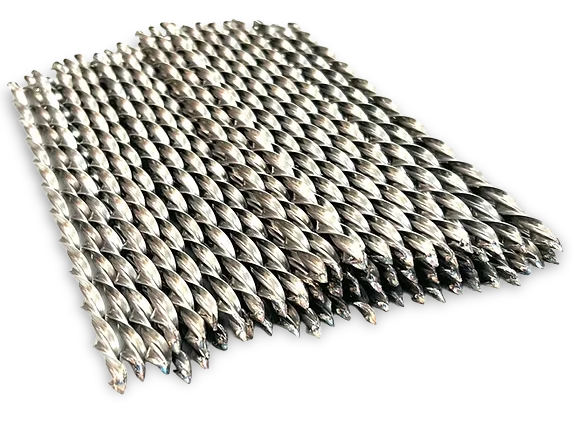
Diagnostic Mapping & Precision Reinstatement
Structural Repairs approaches cavity wall tie failure through empirical diagnosis rather than blind drilling. We deploy a forensic, non-destructive methodology to assess the pathology of the cavity, isolate the threat, and engineer a permanent reinstatement of the wall’s structural integrity.
We do not need to demolish your facade to secure it. Our technicians execute the entire remediation process externally, ensuring the building remains fully operational and occupied.
- Non-Destructive Surveying: We eliminate the guesswork. Using advanced metal detectors and fibre-optic boroscope cameras, we physically map the exact location, density, and degradation level of the existing ties inside the dark cavity.
- Corrosion Isolation: Installing new ties is only half the job. If the original rusted ties are left untreated, they will continue to expand and crack the masonry. We precisely locate the old ties and either physically extract them or mechanically isolate them so their continued corrosion cannot exert force on the mortar joints.
- Engineered Replacement: We drill highly precise pilot holes and install new, high-tensile, marine-grade stainless steel ties. Depending on the exact substrate (e.g., dense concrete block inner leaf vs. soft historic brick), our engineers specify either mechanically expanding neoprene anchors or high-strength structural resin-bonded ties to permanently lock the two leaves back together.
When commissioning a comprehensive structural diagnostic programme, principal contractors require absolute assurance that the spatial data is mathematically flawless. Our scanning teams capture millimetre-accurate point clouds and subsurface metrics that align strictly with the definitive measurement frameworks established by the Royal Institution of Chartered Surveyors (RICS), ensuring your asset data is ready for immediate commercial application.
Cavity Wall Tie Technical FAQ
The most common indicator is regular, horizontal cracking in the mortar joints of the external brickwork, typically spaced every 4 to 6 courses of bricks. You may also notice the wall physically bulging outward, or in severe cases, the lintels above windows beginning to drop or sag as the wall loses its structural cohesion.
No. The entire replacement process is engineered to be non-intrusive. We map the cavity, isolate the old ties, and install the new stainless steel ties through small holes drilled directly into the external mortar beds. Once the installation is complete, the holes are color-matched and repointed, making the structural upgrade virtually invisible.
This is a dangerous practice used by cut-rate contractors. If you leave a heavily rusted mild steel tie embedded in both leaves of the wall, it will continue to oxidise and expand. Even with new ties holding the wall together, the old ties will eventually generate enough expansive force to crack the bricks and blow the mortar out of the wall. They must be physically isolated.
We use specialised fibre-optic boroscopes. By drilling a tiny 10mm hole in the mortar, we insert an illuminated camera directly into the cavity. This provides our structural surveyors with clear, high-definition visual data on the exact level of corrosion on the ties, as well as checking for other hidden issues, such as cavity wall insulation saturation or mortar droppings bridging the damp-proof course.