Reduce risk, avoid programme delays and make decisions based on evidence – not assumptions.

Falling Concrete is a Critical Structural Failure
Commercial Concrete Repair
When chunks of concrete begin falling from the soffits of a multi-storey car park, the facade of a commercial high-rise, or the underside of a civil bridge, you are facing a severe life-safety hazard. Concrete delamination and spalling are not cosmetic defects; they are the terminal symptoms of deep-seated structural pathology. By the time the surface breaks away, the asset’s load-bearing integrity is already heavily compromised.
The Danger of the “Quick Patch”
The construction industry is plagued by reactive, low-quality concrete patching. When a general contractor simply chips away the loose material and fills the hole with standard mortar, they are trapping the underlying disease—usually active rebar corrosion—inside the structure.
Because rusting steel expands up to seven times its original volume, the immense internal pressure will inevitably blow the new patch right back off, or worse, accelerate corrosion in the immediately adjacent concrete (a phenomenon known as the “incipient anode effect”). For asset managers, relying on superficial repairs means paying repeatedly for the same failing works while the structure continues to degrade toward critical failure or condemnation.
Engineered Concrete Reinstatement
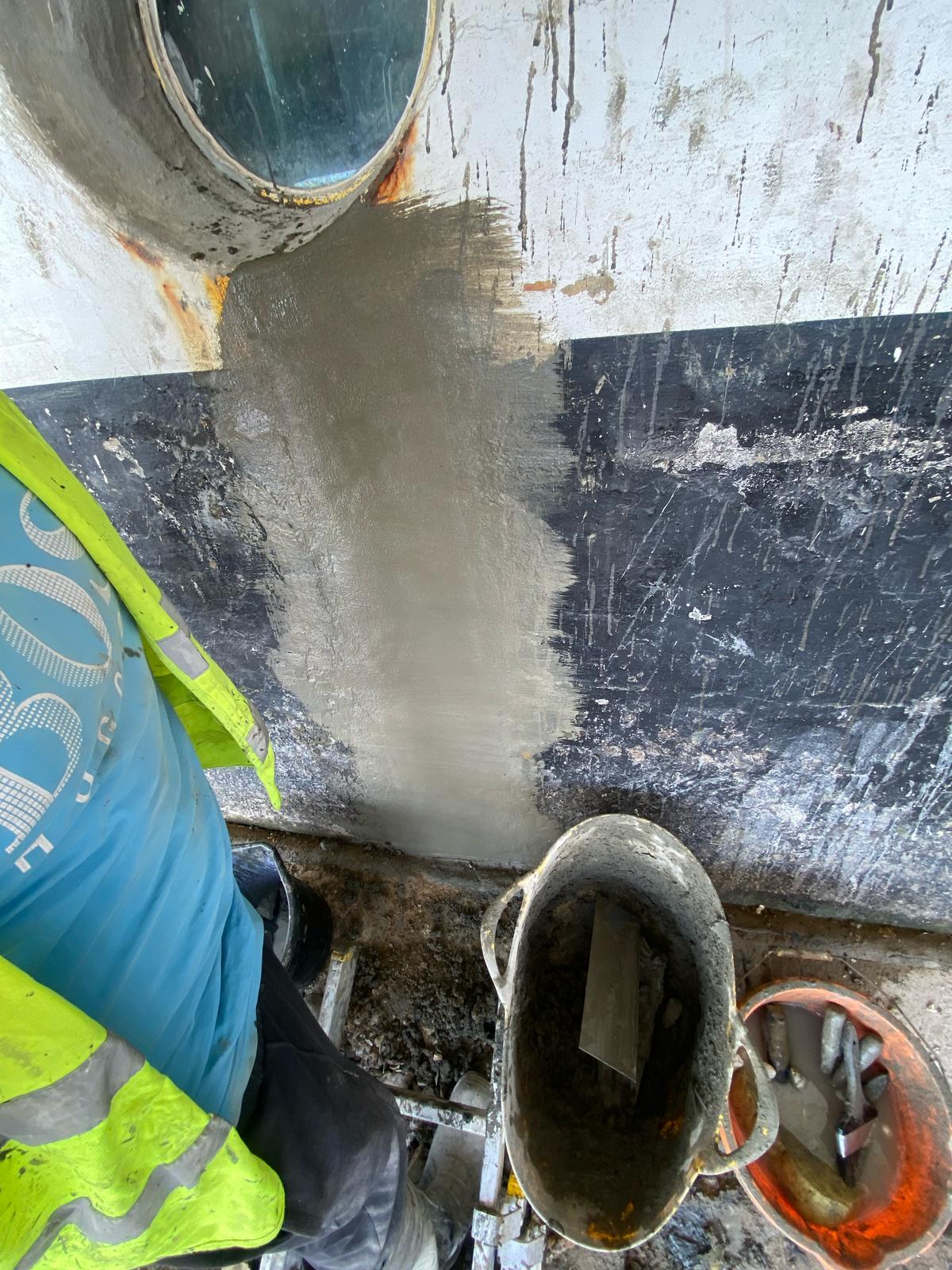
Structural Repairs does not do cosmetic patching. We execute permanent, engineered concrete reinstatement. Our approach treats the root cause of the delamination, physically restoring the tensile and compressive strength of the original matrix.
Before any breakout occurs, we deploy advanced Non-Destructive Testing (NDT) and Ground Penetrating Radar (GPR) to map the exact extent of the invisible corrosion.
Whether we are utilising robotic hydro-demolition to precisely remove contaminated concrete on a massive industrial scale, or applying high-build, polymer-modified repair mortars to a Grade II listed historic facade, every intervention is specified by our structural engineers. We meticulously expose and treat the underlying reinforcement steel, apply advanced anti-corrosion primers, and reinstate the profile using shrinkage-compensated, high-strength micro-concretes that precisely match the physical properties of the host substrate. The result is a monolithic repair that seamlessly integrates with your structure, permanently extending its operational lifespan.
Concrete Repair Technical FAQ
When addressing structural degradation, commercial property managers need empirical data and engineered certainty. Here is how we address the most common technical questions regarding concrete delamination.
The primary cause is the corrosion of embedded steel reinforcement. When moisture, oxygen, and aggressive elements like chlorides (salts) or carbon dioxide penetrate the concrete, the steel rebar begins to rust. This rust expands with massive force, cracking the concrete from the inside and eventually causing the surface layer (the cover) to break away entirely.
A cosmetic repair simply fills a hole with standard mortar, trapping active corrosion inside the matrix and often accelerating adjacent decay via the incipient anode effect. A structural concrete repair involves breaking out the contaminated concrete, chemically treating the exposed rebar to permanently halt oxidation, and rebuilding the profile using BS EN 1504 compliant structural mortars to restore load-bearing capacity.
We achieve a monolithic bond by rigorously preparing the substrate. Using vibration-free robotic hydro-demolition or mechanical breakout, we remove all diseased concrete back to a sound matrix. We then apply specialised anti-corrosion bonding primers and utilise high-strength, shrinkage-compensated micro-concretes that perfectly match the physical and chemical properties of the host structure.
Yes. We understand that commercial assets must remain operational. Our engineering teams deploy robust access solutions, localised debris netting, dust-free extraction tooling, and noise-dampening protocols to execute safe, phased structural repairs in live environments, including occupied high-rises, hospitals, and active multi-storey car parks.