Contact Us
If you have a commercial, industrial, infrastructure or heritage structural repair enquiry, contact us now. We will respond within one working day. Please note we do not provide services for domestic properties.

If you have a commercial, industrial, infrastructure or heritage structural repair enquiry, contact us now. We will respond within one working day. Please note we do not provide services for domestic properties.
Business enquiries:
Whether you manage a multi-storey car park, a 1970s reinforced concrete office frame, a busy distribution warehouse or a retail park, few things create sharper operational anxiety than unexplained concrete deterioration – or the prospect of drilling blindly into a slab without reliable as-built drawings.
A hairline crack across a transfer beam, rust staining on a soffit, a hollow sound beneath an industrial floor slab or a contractor asking where they can safely core 200 service penetrations all carry high commercial stakes: emergency propping, unplanned closures, struck post-tensioning tendons or spiralling remedial bills.
Before breaking out a single square metre of concrete – or signing off a refurbishment or property acquisition – structural engineers recommend non-destructive concrete scanning to see exactly what is happening inside the structure without causing further damage.
At Structural Repair Solutions (SRS), our specialist investigation division (structuralscanning.com) uses Ground Penetrating Radar (GPR), ultrasonic pulse echo and covermeter surveys to give commercial asset owners clear, defensible answers before small defects become major liabilities.
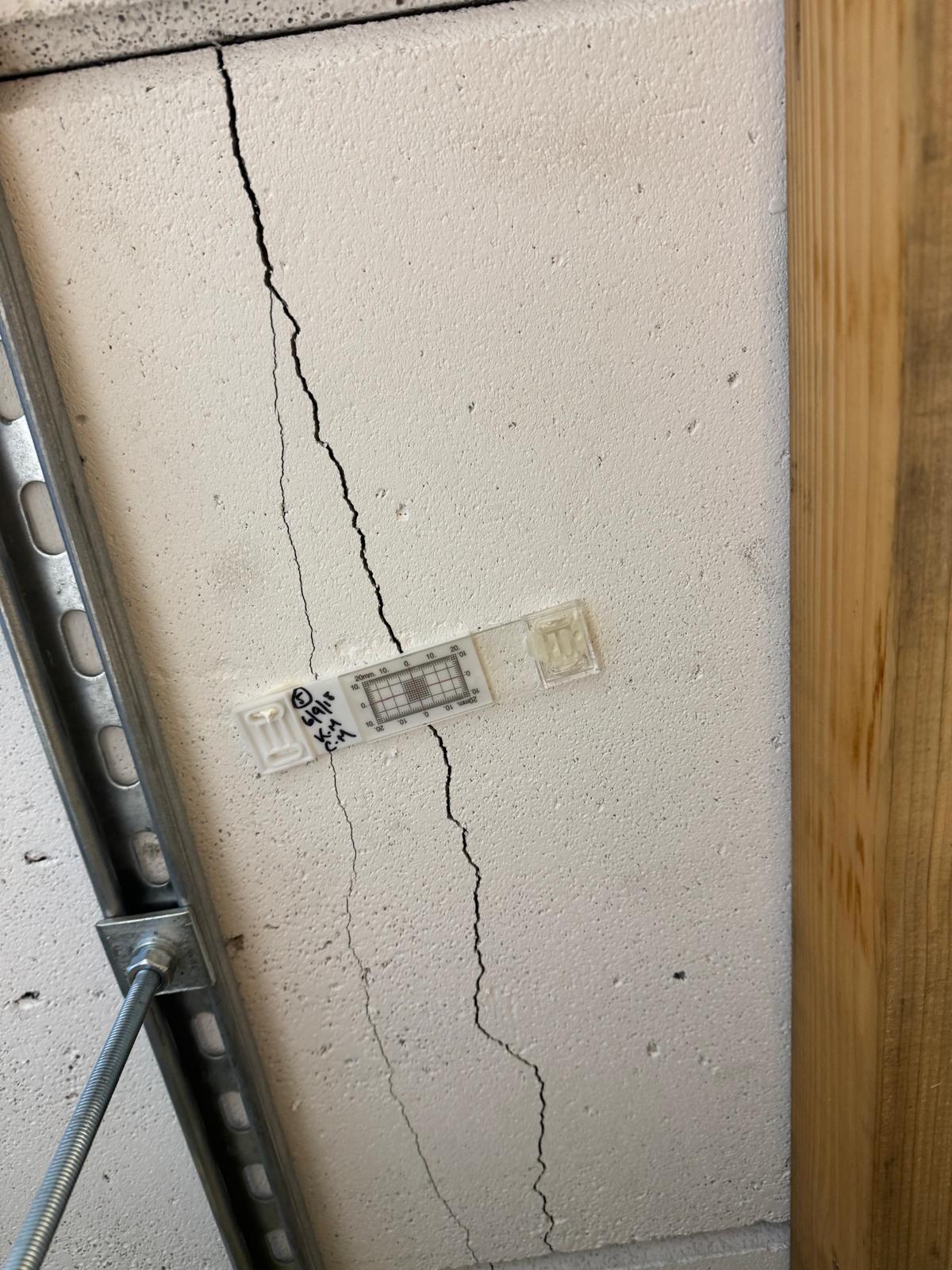
Monitoring cracked concrete – suitable candidate for concrete scanning
Visual walkover surveys only show what has already broken through to the surface. By the time spalling concrete or active water ingress becomes obvious, deterioration inside the slab or frame has often been progressing for years:
Concrete scanning uses non-intrusive electromagnetic and acoustic waves to map the internal anatomy of reinforced concrete in real time – with zero dust, no structural vibration and no disruption to tenants or daily operations.
The worst outcome of a structural survey is an ambiguous report that leaves you no closer to a commercial decision.Because Structural Repair Solutions combines forensic NDT scanning (structuralscanning.com) with specialist in-house remediation (structuralrepairs.com), we bridge the gap between finding the defect and fixing it – scoping targeted, low-intervention repairs that keep your building open and extend its serviceable life.
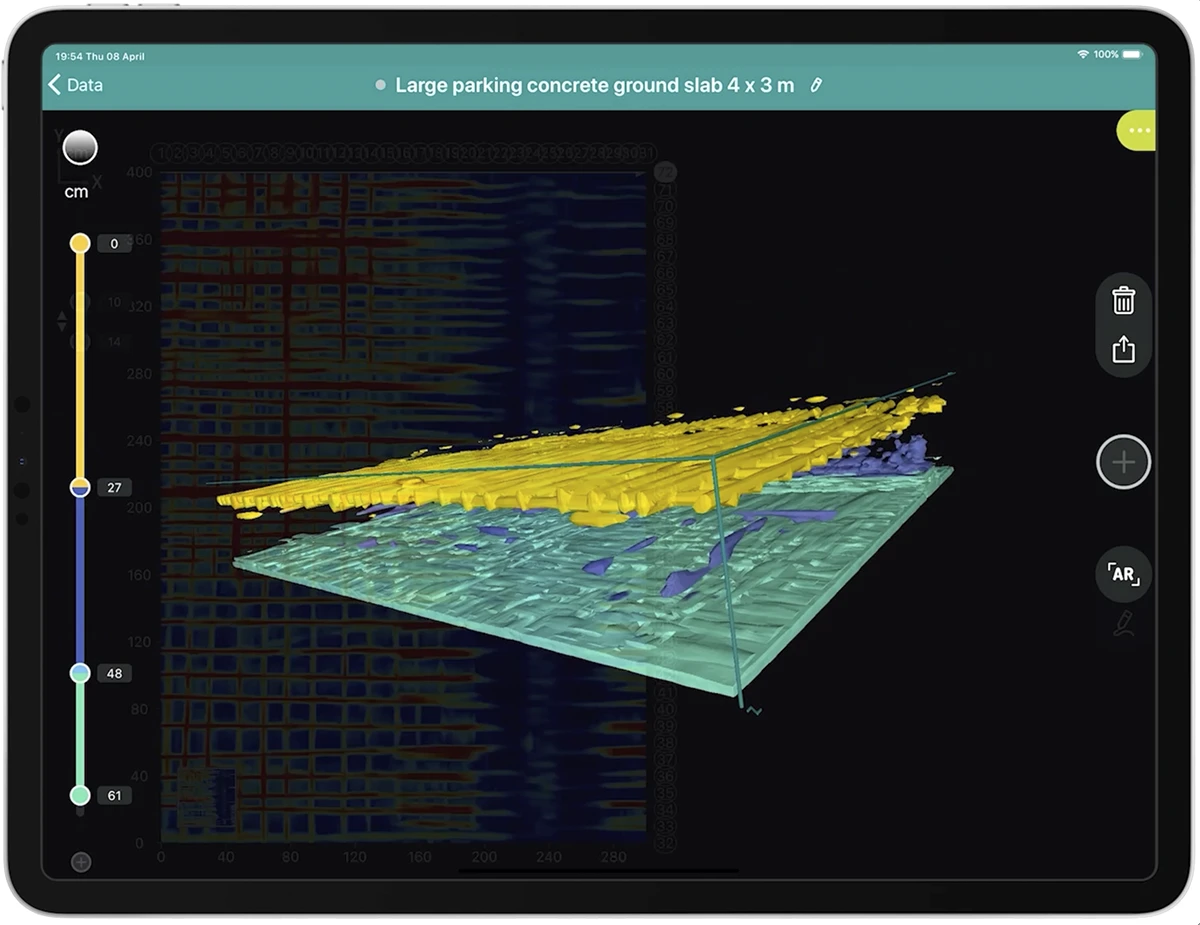
Standard high-frequency Ground Penetrating Radar (GPR) for concrete typically resolves reinforcement, post-tensioning ducts and conduits up to 300–500 mm deep, while lower-frequency GPR antennas and Ultrasonic Pulse Echo (UPE) units can penetrate deeper into thick transfer beams, retaining walls and sub-slab ground layers to detect voids and delamination.
No. Concrete scanning is completely non-destructive and generates no dust, vibration or loud noise. Surveys can be carried out during normal trading hours in occupied offices, retail stores, car parks and distribution centres without closing the building.
Yes. Ground Penetrating Radar (GPR) is widely used across logistics and retail facilities to identify air or water-filled voids beneath ground-bearing concrete slabs caused by sub-base settlement or leaking underground drainage – allowing targeted resin slab stabilisation before the concrete cracks or collapses under heavy plant.
Yes. On commercial sites, as-built reinforcement spacing, cover depths and post-tensioning duct profiles frequently differ from original design drawings, and subsequent fit-outs often leave unrecorded conduits inside the slab. Scanning verifies actual site conditions before drilling or structural alterations take place.
Speak directly with our engineering team on 0300 030 1822 or email [email protected] to arrange a non-destructive concrete scanning survey.